
Our research is based on patients’ needs and aims to improve the treatment of common conditions in ways that are relevant to everyday clinical practice. The goal is to generate knowledge that can be translated into practice and benefit patients, while also taking costs and environmental impact into account.
Close
D-WHIN: Danderyd Wrist and Hand INitiative – Research group
D-WHIN is a research group at Karolinska Institutet, within the Department of Clinical Sciences at Danderyd Hospital. We conduct clinical, interdisciplinary research in orthopaedics and rehabilitation, with a particular focus on hand and wrist injuries, as well as the environmental impact and resource use of healthcare.
Staff and contact
Group leader
- Cecilia Mellstrand NavarroAffiliated to Research
Associate Professor at Karolinska Institutet. I conduct research on upper extremity injuries using clinical trials, registry data, health economics, and sustainability perspectives.  
- Elsa PihlAffiliated to Research
All members of the group
- Michael AxenhusAffiliated to Research | Docent
Associate Professor and group leader at the Karolinska Institute. Leads the group “Translational Clinical Orthopedics,” which acts as a bridge between preclinical and clinical research. 
- Nina BrodinSenior Lecturer/Physcial Therapist | Docent
- Anna JosefssonPhd Student
- Viktor Mili-SchmidtAffiliated to Research
- Sofia SvärdingPhd Student
Other people connected to the group
- Smith, Marianne
The CARBO study
Operation or early mobilisation in metacarpal fractures
About the study
The CARBO study (metaCARpal Bone Osteosynthesis) is an international multicentre study investigating treatment of displaced metacarpal fractures in adults. These fractures are common and account for approximately 30–50% of all hand fractures. Despite this, sufficiently large randomised studies comparing surgical and non-surgical treatment are still lacking.
The aim of the CARBO study is to investigate whether non-operative treatment with immediate mobilisation can provide functional outcomes equivalent to those achieved with surgery with internal fixation. The primary outcome of the study is grip strength in the injured hand one year after injury. The study includes a total of 552 patients and is conducted as a prospective randomised controlled multicentre trial involving hospitals across several Nordic countries.
The results of the study are expected to contribute stronger evidence for treatment decisions in metacarpal fractures and may influence future clinical guidelines.
Study ID at clinicaltrials.gov NCT07357493
Become part of the CARBO Consortium
Is your centre interested in joining the CARBO Consortium?
Please contact Cecilia Mellstrand Navarro at cecilia.mellstrand.navarro@ki.se
Study design
The CARBO study is an international, multicentre, pragmatic, parallel-group randomised controlled trial with a non-inferiority design and 1:1 block randomisation. In parallel, eligible patients who decline randomisation are enrolled in a prospective observational cohort. The trial is being carried out at orthopaedic and hand surgery units in Sweden, Denmark, Finland, and Norway.
Recruitment of participants started in March 2026. Patients presenting with metacarpal shaft fractures, or referred to participating orthopaedic or hand surgery departments for such injuries, are assessed for eligibility. Individuals who meet the inclusion criteria are invited to take part in the study and are provided with both verbal and written study information.
Intervention
Since surgical management currently represents standard care, the experimental intervention in this trial is non-operative treatment with early mobilisation. Participants allocated to the non-operative group will receive guidance from dedicated rehabilitation personnel encouraging immediate and unrestricted movement.
Control
Participants assigned to the operative group will undergo open reduction and internal fixation (ORIF) of the metacarpal fracture under local, regional, or general anaesthesia. The type and duration of postoperative immobilisation will be determined by the treating surgeon, although immobilisation in a plaster cast will not extend beyond two weeks.
Follow up
Patients are assessed at 2 and 6 weeks, as well as at 3 and 12 months. Our primary outcome measure is grip strength at 12 months. Secondary outcomes include complications, general and region-specific patient-reported outcome measures, range of motion, and return to work and sports.
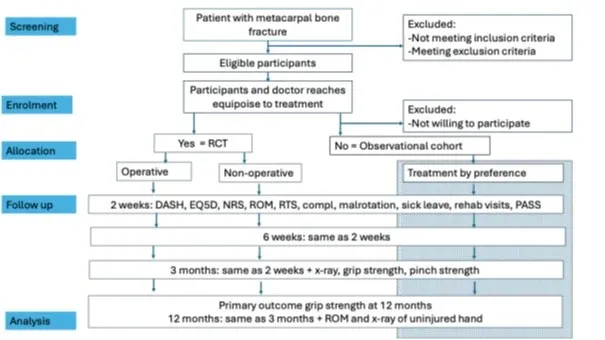
Flowchart of the CARBO study
Photo: N/A
The relevance of the project
Metacarpal fractures are common in the working-age population. Approximately 1000 surgeries are performed annually in Sweden at a cost of SEK 14 000 000 for the surgery alone. Not included are societal costs due to lost productivity and surgical complications. If our study shows that non-surgical treatment is equally effective, we reduce unnecessary operations, complications, and costs, and findings may be generalizable to other hand and finger fractures. The findings could have major clinical implications and contribute to efficient use of healthcare resources. Our project has the potential to influence global treatment recommendations.
Ethics
The study will be conducted in accordance with the Declaration of Helsinki. Ethical approval has been granted by the Swedish Ethical Review Authority (DNR 2025-04413-01; amendment DNR 2025-07659-02 and 2026-03798-02) and the Norwegian Regional Committees for Medical and Health Research Ethics (REK) (DNR 958946)
Patient enrolment progress
The CARBO study aims to enrol a total of 552 patients in the randomised trial.
- 3 June 2026 - Patient recruitment starts at site Östersund
- 1 June 2026 - Patient recruitment starts at site Norrköping
- 19 May 2026: 13 patients have been enrolled
- 23 March 2026: Patient recruitment starts at site Danderyd
- 16 March 2026: The CARBO LinkedIn profile is now available
Research project management
The CARBO study is led by the Danderyd Wrist and Hand INitiative (WHIN) in collaboration with several Nordic research centres.
Elsa Pihl
Assisting Principal Investigator, responsible for database management and coordination of Swedish study sitesAnna Josefsson
PhD student. Patient recruitment, data collection, and follow-up at Danderyd HospitalViktor Mili-Schmidt
Responsible for database management and communication with other study sitesNina Brodin
Quality and safety reviewerSofia Svärding
Responsible for rehabilitation protocols. Data collection, and follow-up at Danderyd HospitalMichael Axenhus
Responsible for safety oversight and data monitoring
Marianne Smith
Patient recruitment, data collection, and follow-up at Danderyd HospitalInternational collaborators
Norway
Endre Søreide – Division of Orthopaedic Surgery, Oslo University Hospital, and Institute of Clinical Medicine, University of Oslo, Oslo, Norway
Finland
Jarkko Jokihaara – Division of Musculoskeletal Diseases, Tampere University Hospital, Tampere, Finland
Denmark
Marcus Landgren – Department of Orthopaedic Surgery, Copenhagen University Hospital, Herlev and Gentofte, Gentofte, and Department of Clinical Medicine, University of Copenhagen, Copenhagen, Denmark
Study sites
The study is conducted at several orthopedic and hand surgery centers across the Nordic countries.
Sweden
- Danderyd Hospital
- Falun Hospital
- Hässleholm Hospital
- Sundsvalls Hospital
- Uppsala University Hospital
- Vrinnevi Hospital in Norrköping
- Östersund Hospital
Norway
- Oslo University Hospital
Finland
- Tampere University Hospital
Denmark
- Copenhagen University Hospital
Funders
- Region Stockholm
- Svenska Läkaresällskapet
- Centrum för idrottsforskning
Contact
Elsa Pihl
Affiliated to ResearchThe CARBO CARBON study
About the study
Aim
To investigate the difference in climate impact between the surgical treatment pathway and the non-surgical management pathway of metacarpal fractures during the first 12 months after initiation of treatment.
Background
Healthcare exists to protect and improve human health, yet it also contributes to environmental challenges that can ultimately affect population health. The healthcare sector is responsible for an estimated 5% of global greenhouse gas emissions, with orthopaedic surgery being one of the more resource-intensive areas of medical care. As healthcare systems strive to deliver high-quality care, there is an increasing need to identify ways to reduce environmental impacts while maintaining patient safety and clinical effectiveness.
Research has shown that a substantial proportion of the environmental footprint of orthopaedic procedures is associated with the use of single-use materials and resource-intensive surgical processes. Furthermore, evidence indicates that a relatively small number of products and processes account for a large share of the environmental burden, highlighting opportunities for targeted improvements.
Environmental sustainability in healthcare extends beyond carbon emissions alone. Comprehensive assessments, such as Life Cycle Assessment (LCA), make it possible to evaluate a wide range of environmental impacts, including resource use, waste generation, water consumption, emissions to air and water, and effects on ecosystems.
Design
Comparative prospective cohort study alongside the CARBO study on selected study sites.
Goal
Our goal is to quantify the difference in environmental impact between the two treatment pathways, surgical and non-surgical management for metacarpal shaft fractures during the first 12 months after initiation of treatment.
Data collection
Data will be collected prospectively in the outpatient clinic, the operating theatre, and during all rehabilitation visits. This includes all products in terms of physical items and their components, energy for heating and ventilation (electricity, gas etc.) and all consumable items, both single use and reusable (plastics, metals, fabrics, other materials, pharmaceuticals, etc.). Transportation of patients to and from hospital visits will also be included.
Outcome measures
Primary
The primary outcome is carbon dioxide equivalent emissions in kilograms (kg CO₂e) for the two treatment pathways, surgical and non-surgical management of displaced metacarpal shaft fractures in adults.
Secondary
Include the mean emissions of ambient air pollution, water consumption for the two treatment pathways and direct costs presented in Euros (€). Exploratory outcomes encompass other environmental impact categories, identification of major emission hotspots (e.g., operating room energy use, single-use materials, pharmaceuticals, patient transport). The total weight of combustible waste.
Significance
The findings from this study may support the development and adaptation of fracture treatment strategies aimed at reducing carbon emissions and promoting more sustainable healthcare.
Ethics
Ethical approval has been granted by the Swedish Ethical Review Authority (DNR 2025-04413-01; amendment DNR 2025-07659-02).
Patient enrolment progress
- 16 June 2026: 16 patients have been enrolled.
- 23 March 2026: Patient recruitment starts.
Research project management
The CARBO CARBON study is led by the Danderyd Wrist and Hand INitiative (D-WHIN) in collaboration with other centres in Sweden.
Elsa Pihl
Principal InvestigatorCecilia Mellstrand Navarro
Assisting principal Investigator. Responsible for coordination of study sites and contact with collaborating researchers. Supervision and quality control