
Lipids are essential regulators of cellular identity, organelle biogenesis, signaling, and metabolic adaptation. Yet fundamental principles remain unresolved: How do cells decide when to store, mobilize, or secrete lipids? How do membranes remodel to generate new organelles? And how do local lipid environments guide protein activity and metabolic outcomes?
Although lipid dysregulation underlies major human diseases, including fatty liver disease, obesity, cardiovascular disease, and neurodegeneration, the molecular logic organizing lipid flux inside cells remains poorly understood.
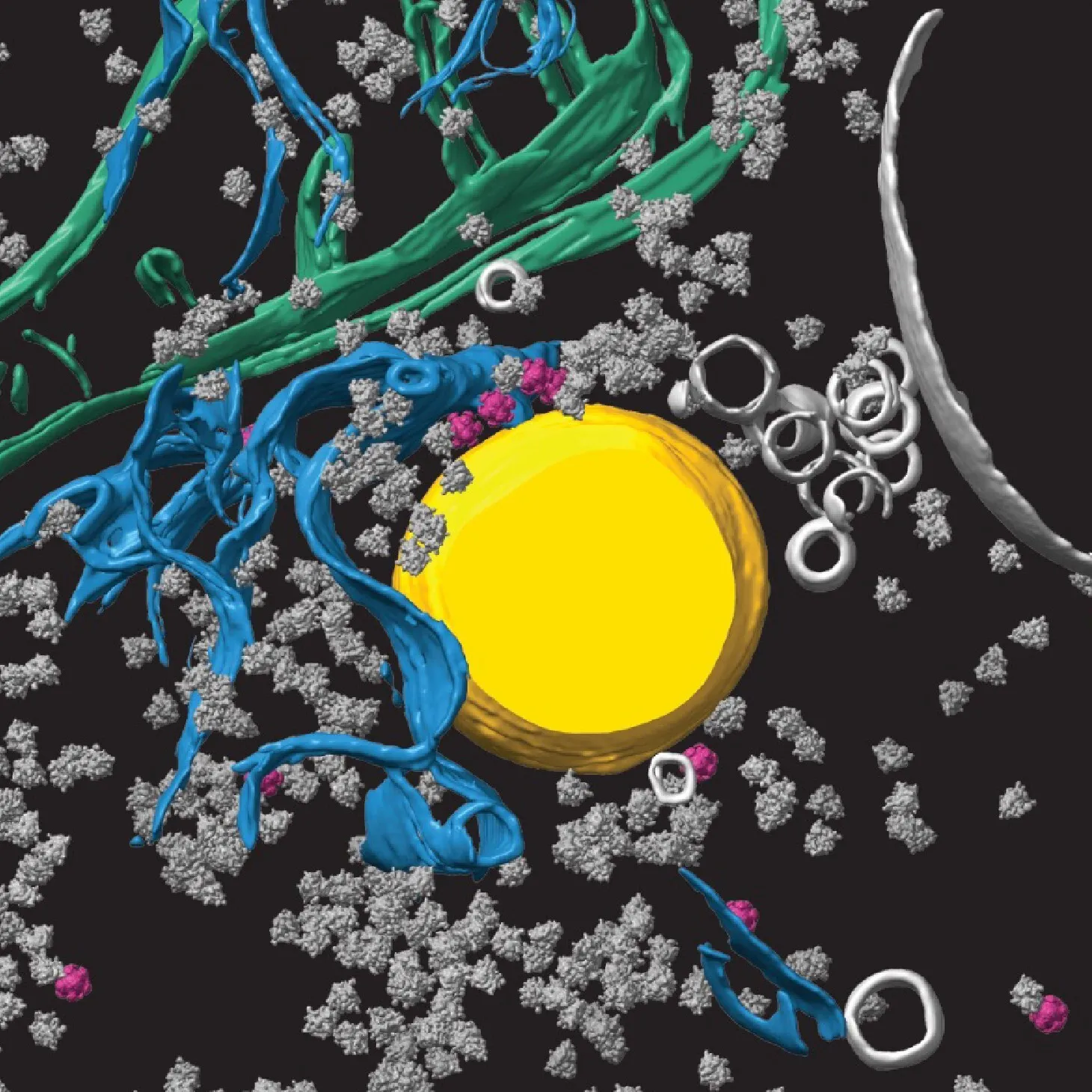
We combine advanced cell biology with in-cell cryo-electron tomography (cryo-ET) and cryo-correlative microscopy to visualize lipid-driven remodeling directly within intact cells. Cryo-ET provides nanometer-scale preservation of membrane architecture and reveals macromolecular machinery in its native state. Genetically encoded nanoparticles (GEMs) enable nanometer-precision protein localization, allowing us to capture rare and transient intermediates of organelle biogenesis. Advances in cryo-FIB lift-out also allow examination of larger, tissue-derived samples. By integrating these approaches, we aim to illuminate how organelles emerge, transform, and coordinate metabolic decisions across scales—from single lipid molecules to whole-cell organization.
Research Themes
1. Nanoscale architecture of LD and VLDL formation
Lipid droplets (LDs) and very-low-density lipoproteins (VLDLs) arise from the same ER membrane but drive opposing metabolic fates. Dysregulation of either pathway contributes to fatty liver disease and dyslipidaemia. We investigate how ER nanodomains bias lipid flux toward LD or VLDL formation.
- What architectural features define LD- versus VLDL-forming ER regions?
- How do early neutral-lipid assemblies evolve into either LDs or VLDLs, and what governs the membrane architectures that guide these distinct metabolic fates?
- How is substrate competition balanced between storage and secretion pathways?
2. Tools for visualizing lipid environments in situ
A central goal of the lab is to observe membrane remodeling in native cellular context. We combine cryo-CLEM, cryo-FIB lamella preparation, targeted fluorescent reporters, controlled lipid-flux perturbations, and subtomogram analysis to map organelle transformations at nanometer resolution. We also explore strategies to resolve local lipid environments, a major challenge in structural cell biology.
- How can distinct lipid species be labeled directly in native membranes?
- How do lipid environments reorganize during organelle remodeling?
- What molecular features define lipid “hotspots” that drive flux?
3. Seipin regulators and control of lipid flux
Seipin is a central organizer of LD biogenesis, yet its regulatory network remains incompletely defined. We study how seipin and its partners shape lipid-flux decisions at specialized ER subdomains.
Key questions:
- How do seipin-associated proteins tune lipid storage?
- How are regulatory cues integrated at nanoscale ER regions?
4. Neutral-lipid homeostasis in metabolic stress
Neutral-lipid pools, LDs, and ER membranes deeply influence cellular responses to metabolic stress. We examine how lipid-flux states and membrane architecture shape susceptibility to lipid-driven dysfunction.
Key questions:
- Where does membrane damage originate under metabolic stress?
- Do LDs buffer or propagate lipid imbalances?
- How do lipid-flux states influence cell fate?
Interested in joining our research group?
Curious and motivated scientists are always welcome to get in touch. If you would like to learn more about our research or explore opportunities in the lab, feel free to reach out to veijo.salo@ki.se
More information about our work is available on our website .