Aging and health – Welmer's research group

We study health in older adults, with special focus on physical function, physical activity, sedentary behavior, and injurious falls.

Research focus

We study health in older adults, with special focus on physical function, physical activity, sedentary behavior, and injurious falls. Our research combines clinical studies (interventions, qualitative studies, and implementation research) with large population-based studies.

Our goals are to increase knowledge regarding:

  • Determinants and consequences of disability, physical inactivity, and injurious falls in older adults  
  • The effect of physical exercise interventions on functioning and health in old age
  • Implementation of evidence-based methods in clinical practice

Read more about our research projects under the "Projects" tab. 
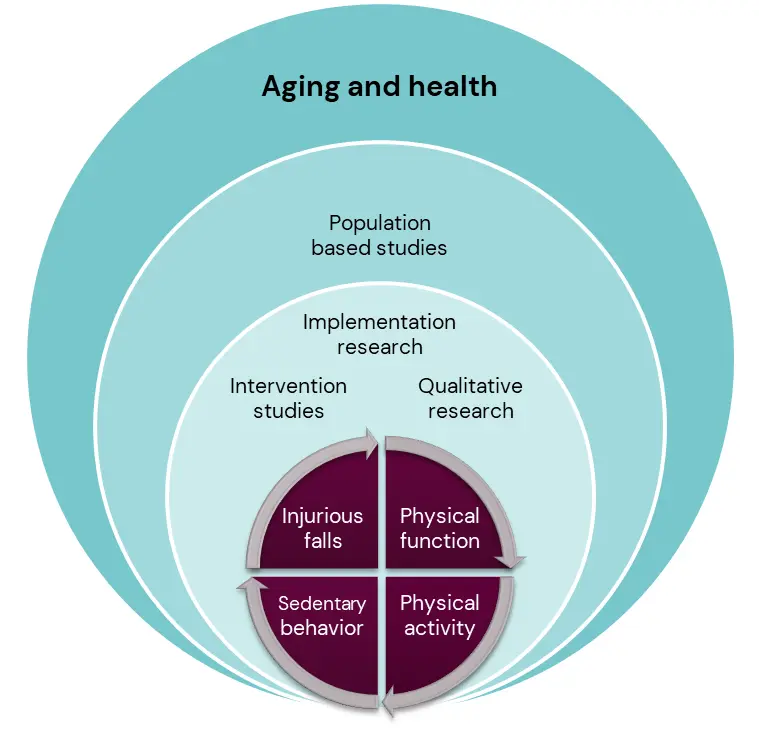
Illustration Anna-Karin Welmers grupp.

Collaborations

We have ongoing collaboration with researchers at the following universities:

  • University of Ferrara, Italy. 
  • Radboudumc, the Netherlands
  • Erasmus MC Rotterdam, the Netherlands
  • University College London, UK
  • Lund University, Sweden
  • Blekinge Institute of Technology, Sweden
  • Vall d'Hebron Institute of Research, Spain
  • Maynooth University, Ireland

News and activities
Publications

Selected publications

Funding

Grants

  • Preventing Functional Decline in Acutely Hospitalized Older Patients: Effects of a Three-Arm Randomized Controlled Trial, Patient Experiences, and Secondary Analyses
    Research School in Health Science (FiH)
    25 August 2025 - 24 August 2029
  • Swedish Research Council for Health Working Life and Welfare
    1 January 2025 - 31 December 2028
    Research Problem and QuestionsDementia presents a significant challenge to healthcare systems. The complex nature of the condition requires individuals and their caregivers to engage with multiple healthcare sectors, necessitating coordinated, person-centred care across various providers. However, several barriers impede the effective delivery of holistic care. As a result, the urgent need for coordinated, person-centred care for individuals with dementia remains largely unmet.This project aims to address these challenges by focusing on the intersections and collaboration across systems, ultimately providing practical recommendations to support coordinated and person-centred care for people with dementia. The specific questions we aim to address are: 1) To what extent does care fragmentation occur among people with dementia? 2) What are the volume and trajectory of care transitions among patients with dementia? 3) What are the unmet needs and potential solutions for coordinated, person-centred dementia care?Data and MethodsThis project will adopt an innovative approach from observation to implementation, by leveraging data from the Swedish National Study on Aging and Care in Nordanstig (SNAC-N, n=766), the Screening Across the Lifespan Twin Study (SALT, n=44,919), and the National Swedish Register for Cognitive/Dementia Disorders (SveDem, n=129,387). Additionally, we will conduct qualitative studies further to understand dementia care and the well-being of caregivers.Societal Relevance and UtilisationDementia care in Sweden has faced criticism for structural deficiencies, such as fragmentation and poor coordination. There is limited knowledge about how different care providers coordinate in practice. This project aims to enhance our understanding of how collaboration in dementia care occurs and how it is experienced by various care providers. A comprehensive investigation of these issues is essential for optimizing the dementia care process and establishing an effective model for care collaboration.Plan for Project RealisationThe project is grounded in well-established cohort studies and an extensive dementia registry that encompasses both specialist and primary care at national and regional levels. These are complemented by qualitative studies involving patients with dementia and their caregivers. Through the collaborative efforts of a multidisciplinary team, this project offers a unique opportunity to address significant knowledge gaps in dementia care.
  • Harmful Sitting in Older Age – Towards Individualized Interventions
    The Mälardalen Area Research School in Health care Science (MoF-V)
    1 January 2024 - 31 December 2027
  • Harmful sitting in old age—using epidemiological and qualitative approaches to tailor future interventions
    Strategic Research Area Health Care Science (SFO-V)
    1 January 2023 - 31 December 2024
  • Preventing functional decline in acutely hospitalized older patients – effect of a simple exercise program versus individualized multicomponent training (PREV FUNC study)
    Konung Gustaf Vs och Drottning Victorias Frimurarestiftelse
    1 March 2022 - 2 March 2025
  • Preventing functional decline in acutely hospitalized older patients – effect of a simple exercise program versus individualized multicomponent training (PREV FUNC study)
    ALF Medicine
    1 March 2022 - 31 December 2027
  • Swedish Research Council for Health Working Life and Welfare
    1 November 2021 - 31 October 2026
    Older adults who are hospitalized because of acute medical illness often experience worsening of physical function, and the transition from hospital to home may pose an additional risk. Even relatively small amounts of exercise might mitigate the risk of physical impairment, emphasizing the importance of identifying efficient and easy-to-use exercise interventions for older hospitalized people.In this project, we aim to 1) to examine if a transitional care program consisting of walking and sit-to-stand exercises performed during acute hospitalization and as self-training at home has effect over usual care concerning physical function in people aged 75 years and older, 2) perform a process evaluation during the different phases of the project, and, 3) translate the knowledge into clinical practice.We will conduct a randomized controlled trial. Participants aged 75 years and older will be included consecutively from geriatric medical wards of two hospitals in Region Stockholm. The intervention starts at the hospital and continues at home six weeks after discharge. The primary outcome is the score on the Short Physical Performance Battery (SPPB) at three months after discharge. Secondary outcomes are SBBP at hospital discharge, and the number of hospital readmissions six months after discharge.The project will include a pilot study to explore the feasibility and optimize the research design, and a process evaluation to assess the quantity and quality of what was delivered and the role of context. In the final phase of the project, we will provide a description of the changes needed to translate the intervention into different settings, which will be helpful for further implementation.Most previous exercise intervention studies in older adults were performed either at the hospital or at home. Thus, the proposed transitional care project may provide a novel strategy to maintain or improve physical function in this frail and vulnerable group.
  • Swedish Research Council for Health Working Life and Welfare
    1 January 2019 - 30 September 2022
  • Swedish Research Council for Health Working Life and Welfare
    1 October 2017 - 30 September 2022
  • Swedish Research Council for Health Working Life and Welfare
    1 January 2017 - 31 December 2023
  • Injurious falls in older adults: identifying people at different levels of risk—from epidemiology to implementation research
    Doctoral School in Health Care Sciences (FiV), Karolinska Insitutet

Staff and contact

Group leader

All members of the group

Visiting address

Karolinska Institutet, Department of Neurobiology, Care Sciences and Society, Alfred Nobels allé 23, B3, Huddinge, SE-141 83, Sweden

Postal address

Karolinska Institutet, Neurobiology, Care Sciences and Society, Division of Physiotherapy 23100, Huddinge, SE-141 83, Sweden

Projects

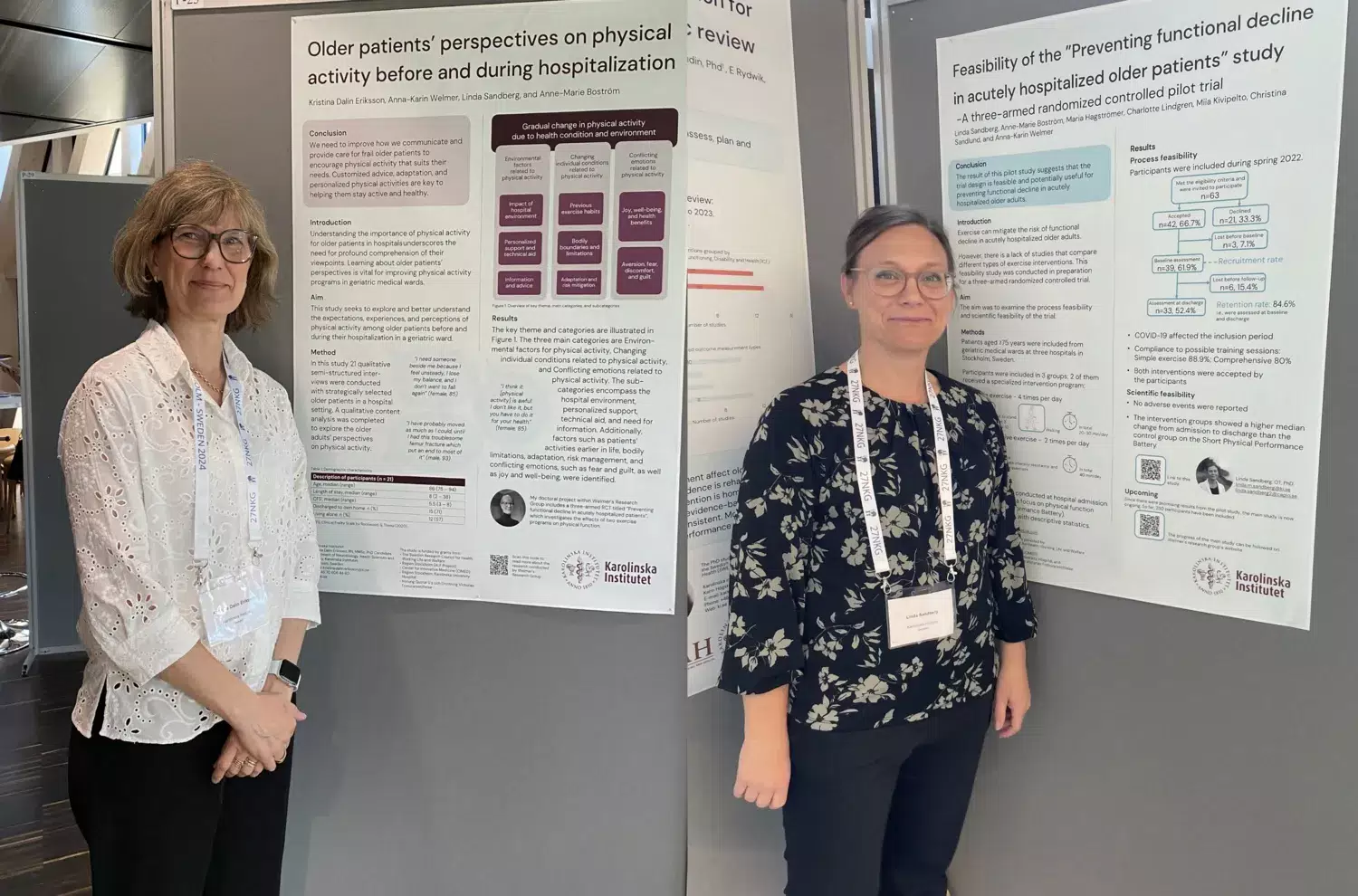
PREV_FUNC: Preventing functional decline in acutely hospitalized older patients

Focus: Adults ≥75 years from geriatric wards in three Stockholm hospitals.

  • Three-armed randomized controlled trial testing two multicomponent exercise programs on physical function. 
  • Qualitative studies exploring experiences of patients and healthcare professionals.

Publication:

Study protocol for the 'preventing functional decline in acutely hospitalised older patients (PREV_FUNC)' study: effects of two multicomponent exercise programmes on physical function - a three-armed randomised controlled trial.
Welmer AK, Sandberg L, Sandlund C, Björck C, Hagströmer M, Hamilton J, Helgstrand G, Lindgren C, Nordstrand L, Sandstedt P, Kivipelto M, Boström AM
BMJ Open 2023 Aug;13(8):e070885

Dance for health – a feasibility study of a dance-based intervention to improve physical function and quality of life in geriatric outpatients ≥65 years 

Focus: Adults ≥65 years attending geriatric outpatient clinics.

  • 10-week, weekly group dance intervention based on the Dance for Parkinson’s method. 
  • Evaluates feasibility, effects on physical function, and quality of life. 

Harmful sitting in old age—using epidemiological and qualitative approaches to tailor future interventions

  • Quantifies associations between movement behaviours (e.g., step count, sitting time) and outcomes like mortality, health changes, and falls. 
  • Explores older adults’ perceptions of factors influencing sitting and physical activity. 

Identifying older adults at risk for falls: from observation to implementation

  • Investigates risk factors for injurious falls. 
  • Tests a falls screening tool in primary care and memory clinics. 
  • Develops predictive models and explores implementation requirements. 

Student engagement in doctoral education

  • Studies active pedagogical methods in doctoral courses. 
  • Explores experiences of both students and teachers.