

Dagliyan Lab

Our research group explores the multiscale mechanisms of neuroplasticity in the mouse brain, spanning from the molecular dynamics of proteins to the systems-level reorganization of neural circuits. By combining cutting-edge tools to probe, perturb, and engineer these processes, we aim to decipher how adaptive changes in brain cells underlie learning, memory, and behavioral plasticity, ultimately providing insights into cognitive enhancement and therapeutic strategies for neurological disorders.

Dagliyan lab logo

Probing and Engineering “Extrinsically Disordered and Ordered Proteins”

In the Dagliyan Lab, we are dedicated to unraveling one of life’s most profound mysteries: how proteins, through regulated structural order-disorder transitions, orchestrate cellular processes, including those that govern neuroplasticity, learning, and memory consolidation. We also engineer these mechanisms to control protein dynamics in vivo.

Onur Daglyian Lab
Proteins are not static entities; they are dynamic molecules that transition between various structural states. We hypothesize that extrinsic disorder plays a pivotal role in facilitating these structural transitions. Moreover, this mechanism can be harnessed and engineered by precisely modulating the order-disorder transitions of proteins through the strategic design of allosteric regulation.

To address this question, we employ cutting-edge technologies to explore protein dynamics in living systems with unprecedented precision. We engineer proteins to manipulate and visualize protein activity in the brains of living mice, delve into the transcriptomic and epigenomic landscapes of individual neurons to uncover the molecular signatures of plasticity, and utilize machine learning-based tools to decode complex mouse behaviors, linking them to underlying neural processes. Through advanced recording and imaging techniques, we capture neuronal activity both ex vivo and in vivo, offering a window into the brain function.
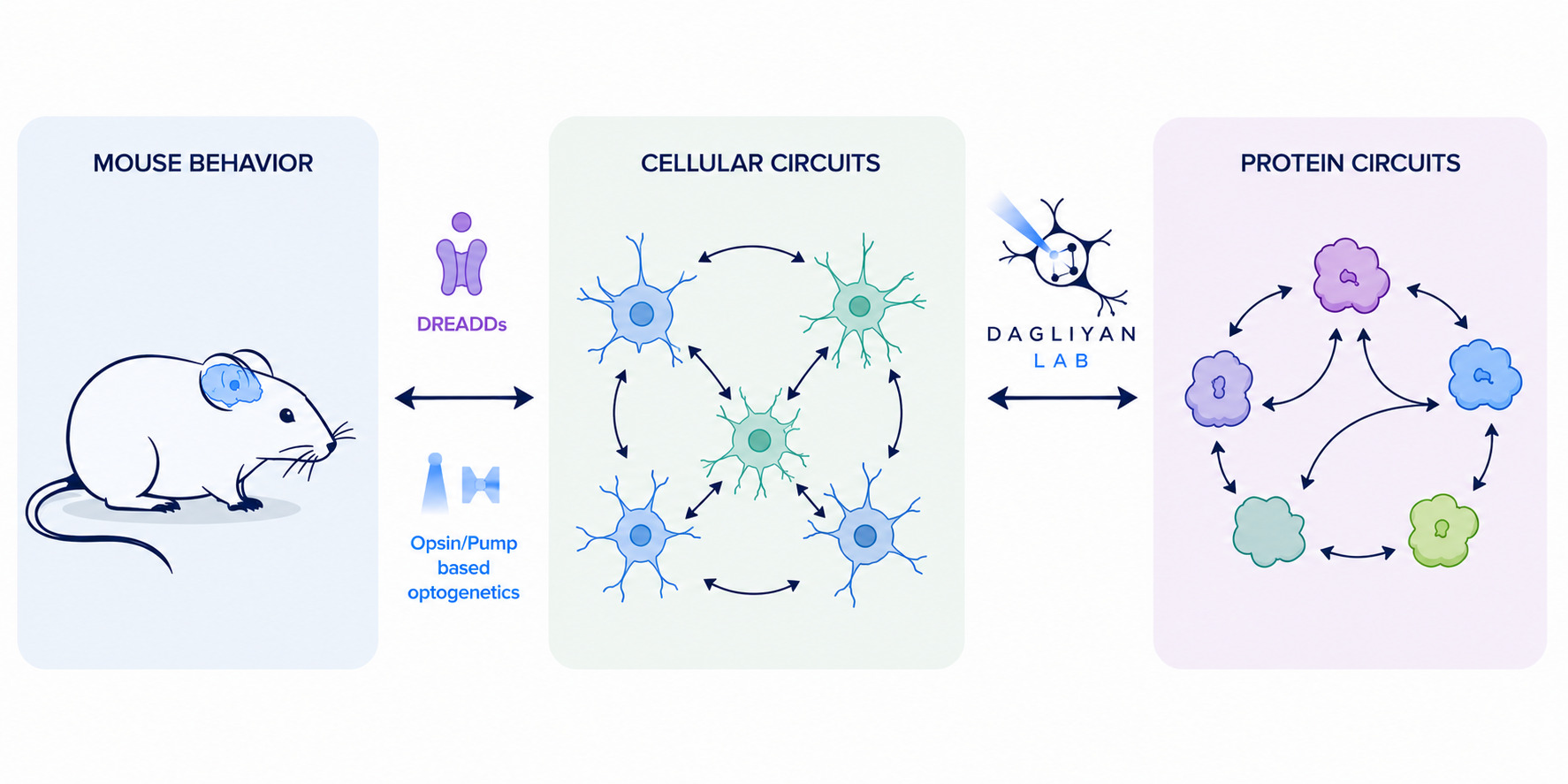
Bridging time and length scales of proteins circuits, neuronal circuits, and behavior.

Our ultimate goal is to decipher the molecular codes by which neurons translate dynamic protein behavior into functional and behavioral plasticity, using mouse models as a foundational system. By bridging bioengineering, molecular biophysics and systems neuroscience, we aim to uncover fundamental principles of brain function and pave the way for novel treatments for neurological and psychiatric disorders. 

Probing Extrinsic Disorder

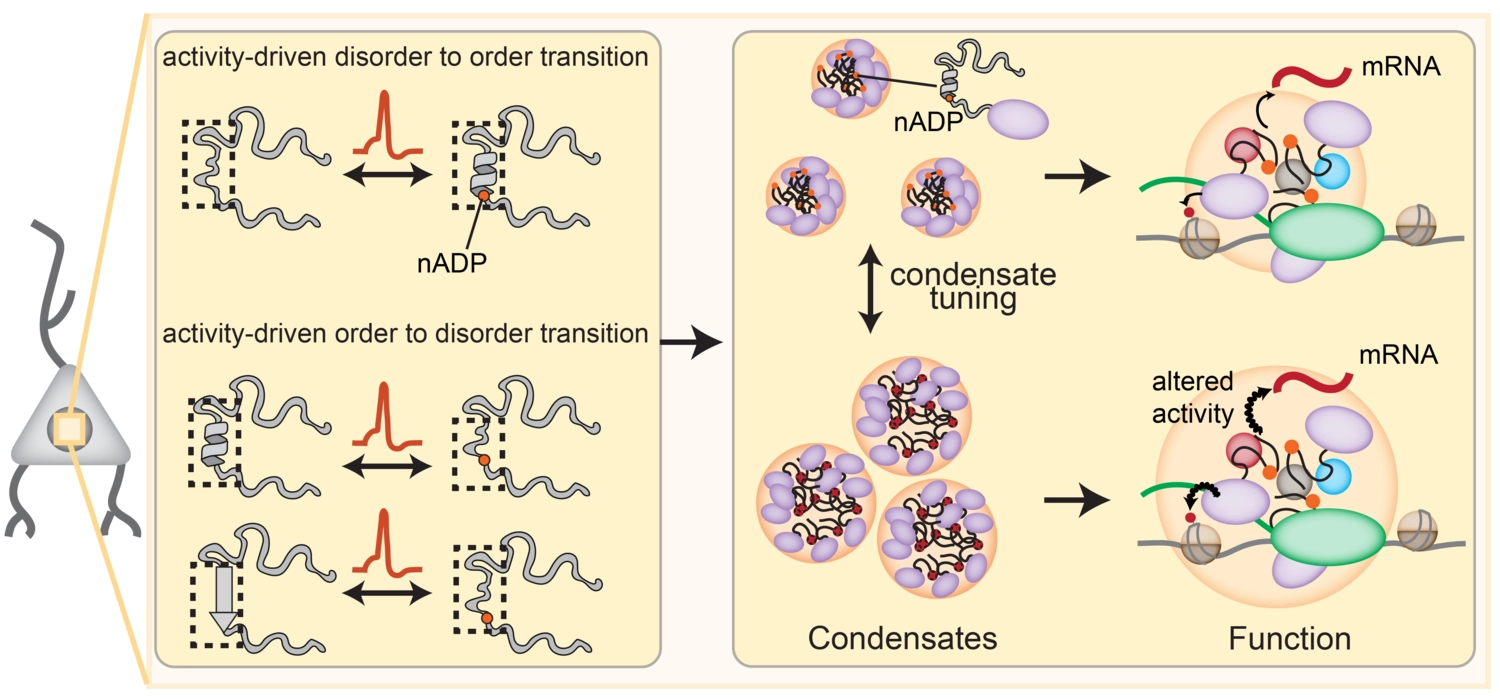
Proteins are the workhorses of life, and their ability to switch between states through extrinsic disorder is a fundamental driver of biological processes. Our lab focuses on the extrinsic disorder of proteins and its role in cellular function. Recently, we discovered mechanisms that mediate the disorder-order transitions of proteins, regulating their organization and function in neurons (Dagliyan et al., 2025). Disrupting these transitions impairs neuronal function and behavior, underscoring their critical importance. 

Tracing order-disorder transitions of proteins in nuclei. 
Lab illustration
Neuronal activity dependent phosphorylations (nADPs) induce local disorder-to-order or order-to-disorder transitions, located within IDRs. These changes modulate condensation dynamics. Dysregulated condensate dynamics due to disrupted nADP impair activity-dependent histone methylation deposition and co-transcriptional splicing, resulting in impaired neuronal function and mouse behavior.

Engineering Extrinsic Disorder

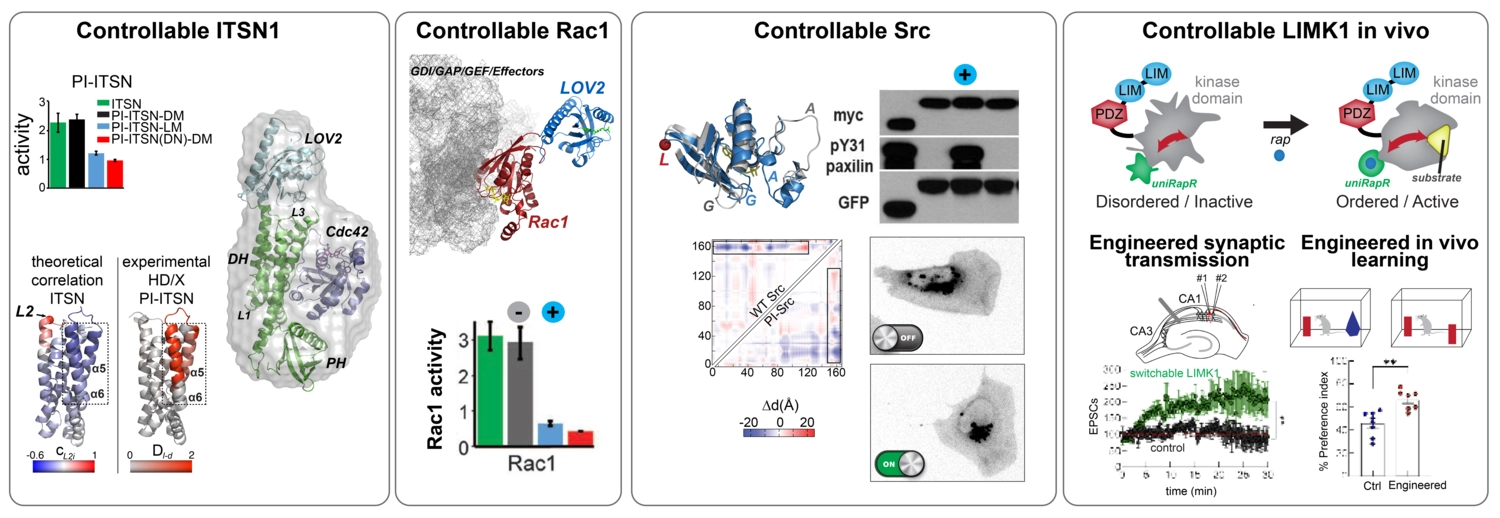
We also engineer extrinsic disorder to achieve precise control over protein function. One application of this approach is in the study of cell motility, a process that, like many others, is tightly coordinated in space and time. A network of proteins, including GTPases, kinases, GEFs, and others, dynamically orchestrates this process. By designing engineered, extrinsically disordered versions of these proteins, we have successfully manipulated information flow within this network, thereby controlling the motility of fibroblasts, cancer cells, neurons, and neutrophils. This has been achieved through allosteric control of extrinsic disorder using drug- or light-responsive proteins ((Dagliyan et al., 2013; Dagliyan et al., 2016; Dagliyan et al., 2017; Dagliyan et al., 2018; Dagliyan et al., 2019). Below are some examples of engineered extrinsically disordered proteins.
Lab illustration
Examples of engineered extrinsically disordered protein. Extrinsically disordered Guanine exchange factors ITSN1, Rho GTPase Rac1, Src kinase. On the very right: Engineered extrinsically ordered LIMK1. Its engineered control enables controlled synaptic transmission in the mouse hippocampus.

A fibroblast expressing engineered extrinsically disordered Src kinase and cell polarized movement is controlled with light. 

A further application involved the design of an extrinsically disordered kinase (LIMK1), which allowed us to precisely manipulate the molecular mechanisms underlying memory formation (Ripoli and Dagliyan, 2023). This engineered kinase, with tunable order-disorder transitions, functioned as a molecular switch that could be activated or deactivated on demand. The results were remarkable: we enhanced memory formation in mice, offering groundbreaking insights into the molecular basis of neuroplasticity. 

By harnessing the dynamic nature of protein disorder—whether in fully disordered proteins or localized regions of structured proteins—we can design proteins with novel functions, opening new avenues for treating neurological disorders and enhancing cognitive function. In our lab, we combine AI-mediated quantification of mouse behavior, two-photon microscopy for imaging, and in vivo manipulation of protein activity in the mouse brain.  

DeepLabCut mediated tracing of mouse behavior. 

The Future of Extrinsic Disorder Research

As we continue to unravel the mysteries of extrinsic disorder and refine our ability to engineer it, we aim to apply these principles to uncover new biological mechanisms and develop transformative technologies for human health. We have demonstrated that protein disorder-order transitions are essential for a wide range of cellular processes, from synaptic transmission and cell motility to protein condensation-mediated gene expression. The possibilities for future discoveries are limitless. 

We are eager to collaborate with like-minded researchers who share our passion for understanding protein disorder-order dynamics and leveraging these insights to decode the language of nature and engineer life itself.
Publications

Selected publications

Funding

Research support

  • European Research Council (ERC)
  • Swedish Research Council (Vetenskapsrådet)
  • Svenska Sällskapet för Medicinsk Forskning (SSMF)
  • The Swedish Brain Foundation (Hjärnfonden)
  • The Strategic Research Area Neuroscience (StratNeuro)
  • Stiftelsen för Strategisk Forskning (SSF)
  • Knut and Alice Wallenberg (KAW) Foundation 
  • Wenner-Gren Foundation
  • Karolinska Institutet

Staff and contact

Group leader

All members of the group

Visiting address

Karolinska Insitutet, MBB, Division of Molecular Neurobiology, Biomedicum 6C, Stokcholm, Sweden

Postal address

Karolinska Institutet, Division of Molecular Neurobiology, Tomtebodavägen 16, Solna, 17165, Sweden

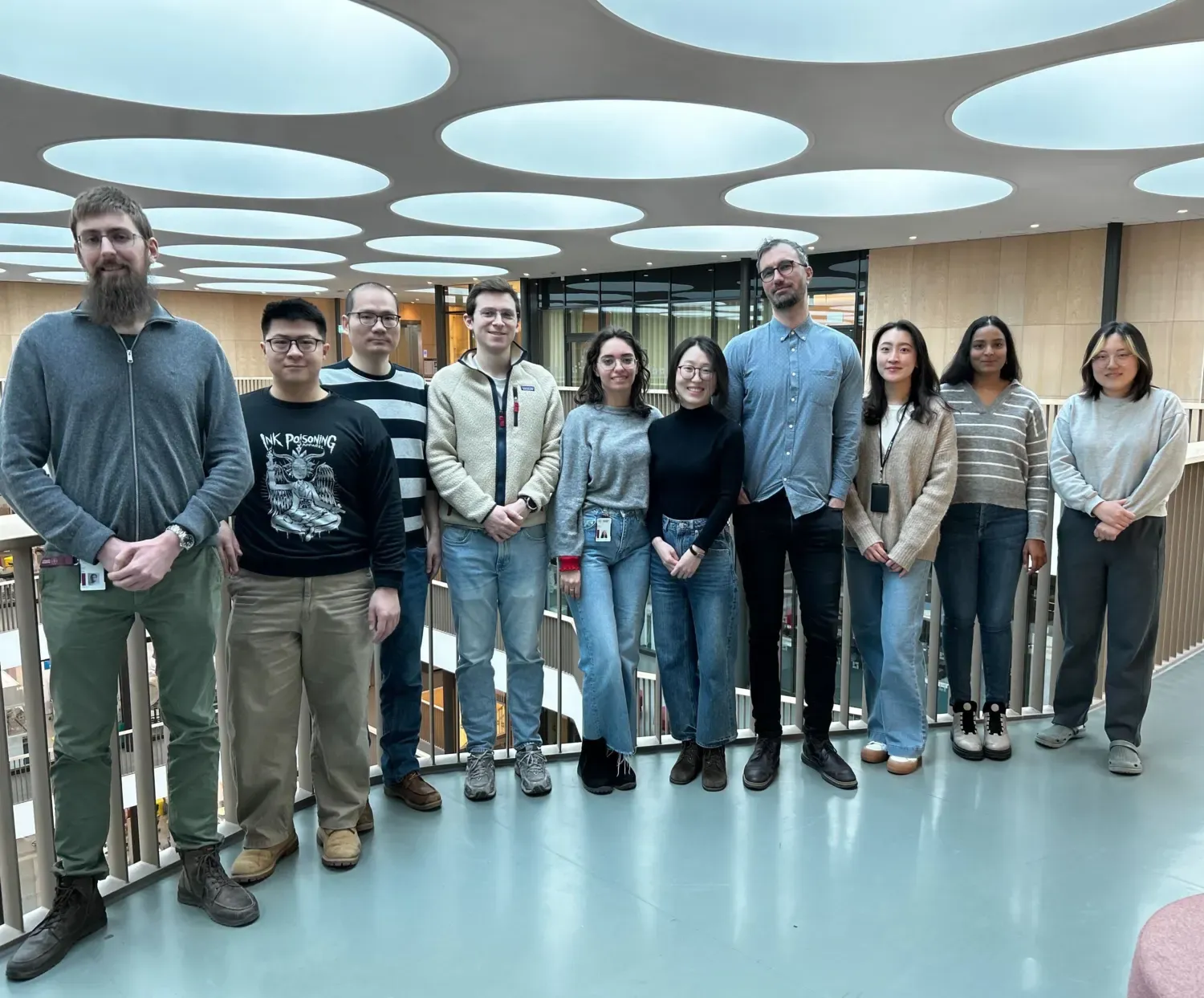
Onur Dagliyan lab members
Onur Dagliyan lab members Photo: N/A

Co-advised PhD Students

Celia Aguilar Ruiz, Thibault Merkelijn

Research Environment

Our research group is based at the Division of Molecular Neurobiology (MolNeuro) at Karolinska Institutet (KI) in Stockholm, Sweden, within the Departmenf of Medical Biochemistry and Biophysics. We work in a collaborative and stimulating environment shaped by a strong belief in people, shared ideas, and scientific curiosity. Our division brings together expertise across different fields of neurobiology and cancer creating a vibrant intellectual community with access to state-of-the-art resources in single cell technologies and advanced imaging at MBB, the KI campus, and SciLifeLab. In this setting, we aim not only to uncover fundamental biological principles, but also to train, support, and inspire the people who make science possible.


Alumni

Postdoctoral Fellows

Roberto Garcia Swinburn (from the Arenas Lab), Krizia Sanna


Co-advised PhD Students

Jokubas Janusauskas (with Sten Linnarsson)


Research Technicians

Celia Aguilar Ruiz, Zeynep Özahıshalı


M.S students

Livia Ceresnova, Florian Schmitz, Yu-Hsuan Hu, Zeynep Ozahishali, Yu (Ivy) Zhang


Visiting PhD students

Francesco Pastore (UNICATT Rome), Martina Battistoni (UNICATT Rome), Chiara Simone (UNICATT Rome), Sara Martini (UNICATT Rome)


Bachelor students:

Alexandra Ogebjer (Lund University), Müge Berber (University of Toronto), Tanja Paul (KI), Pranati Chalasani (KI), Klara Gesché (KI),  Linn Thies (KI),  Qazi Samayeen Rahman (KI), Aurora Boschini Roine (KI)


News and outreach

Interview by Hjärnfonden: Ny forskning om vad som händer i hjärnan vid autism

https://www.hjarnfonden.se/2026/04/ny-forskning-om-vad-som-hander-i-hjarnan-vid-autism/

News: StratNeuro awards new Technology Grant

https://news.ki.se/stratneuro-awards-new-technology-grant

News: Seven KI researchers receive funding from SSMF

https://news.ki.se/seven-ki-researchers-receive-funding-from-ssmf

News: Three KI researchers are awarded the 2022 ERC StG

https://news.ki.se/three-ki-researchers-are-awarded-the-2022-erc-stg

News: Four international researchers receive StratNeuro Startup funding package

https://news.ki.se/four-international-researchers-receive-stratneuro-startup-funding-package


Keywords:
Biochemistry Biochemistry Biophysics Biophysics Biosensing Techniques Cell and Molecular Biology Learning Memory Neurobiology Neuronal Plasticity Neurosciences Neurosciences Optogenetics Protein Engineering Show all
Content reviewer:
Sara Lidman
25-05-2026