Unit of Occupational Medicine

The aim of our research is to identify and prevent chemical, physical, ergonomical and psychosocial health hazards in the work environment. Our main activities include research, education and dissemination of information. The unit takes part in education of medical students, occupational health nurses and physicians, and specialists in occupational and environmental medicine.

The Unit of Occupational Medicine conducts research, education and collaborative activities aimed at advancing knowledge of how working conditions affect health and promoting a sustainable and healthy working life. The unit comprises five research groups and approximately 80 employees and affiliated researchers with expertise in occupational medicine, epidemiology, ergonomics, occupational health, exposure assessment and public health.

Research on occupational health and working conditions

Our research covers chemical, physical, ergonomic, organisational and psychosocial factors in the workplace. We investigate how occupational exposures, working conditions, employment arrangements and changes in the labour market affect health and well-being.

Through epidemiological studies, workplace measurements, register-based research and intervention studies, we examine associations between working conditions and health outcomes, including cardiovascular disease, cancer, mental health problems, pregnancy outcomes, musculoskeletal disorders and work ability. Our research is conducted through national and international collaborations and also addresses digitalisation, emerging forms of work and sustainable working life.

Research infrastructure and tools

The unit develops and maintains research tools for assessing and analysing occupational exposures. These include SweJEM, a national research infrastructure, and EuroJEM, an international research infrastructure. Both provide job-exposure matrices that enable harmonised exposure assessments in epidemiological studies.

Education and professional development

The unit has extensive educational responsibilities, including the Master's Programme in Work and Health at Karolinska Institutet. Our staff also contribute to medical education, doctoral education, and professional training and continuing education in occupational medicine and occupational health services.

Through the national government assignment Kompetenslyft Företagshälsovården, we work to strengthen professional competence and workforce development within occupational health services in Sweden. The initiative includes national coordination, professional networks, and the development of education and continuing professional development opportunities in collaboration with universities, public authorities and other stakeholders.

Scientific publishing and knowledge dissemination

The unit is also responsible for the scientific journal Arbete och Hälsa (Work and Health), which has published scientific research and reviews in occupational health and work-related health since 1967. Through research, scientific publishing and collaboration, we contribute to making scientific knowledge accessible and applicable to preventive occupational health and safety practices.

Collaboration with the Centre for Occupational and Environmental Medicine (CAMM)

The unit works closely with the Centre for Occupational and Environmental Medicine (CAMM) at Region Stockholm. CAMM focuses on identifying, assessing and preventing work-related and environmental ill health through clinical assessments, research, education and knowledge dissemination.

Our collaboration encompasses research, teaching and the development of knowledge that can be translated into practical preventive measures in occupational and environmental health.

Learn more about CAMM

Research groups

Staff and contact

Head of Unit

All members of the group

Education

three people, two guys and girl at a small table filled with papers and a computer
Photo: Pexels-William Fortunato

Master's programme in Work and Health

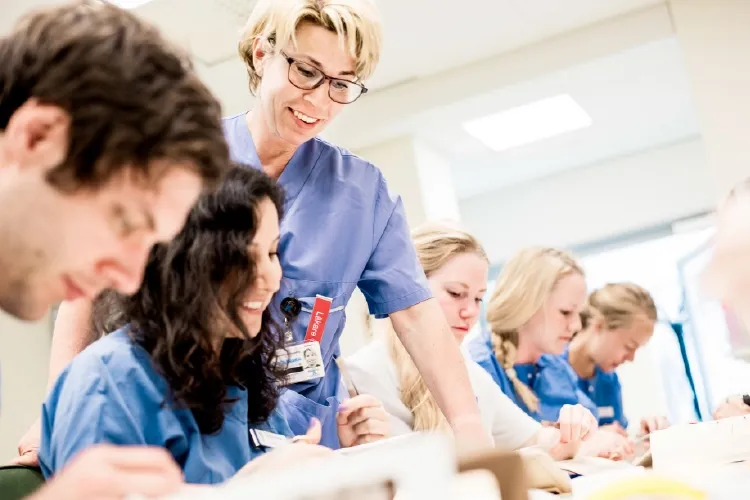
Our unit is responsible for the Master's Program in Work and Health, where our staff from the unit, IMM, and the Center for Occupational and Environmental Medicine, Region Stockholm, teach. The program is part-time (50%) and starts every autumn semester.

The program aims to equip students with scientifically grounded knowledge and skills in occupational health and work-related well-being. This prepares them to work in occupational health services or other organizations and authorities focused on promoting health and improving working conditions. It also provides the expertise needed to prevent ill health and exclusion from the workforce. The program offers three specializations:

Occupational Safety and Health Management: 

This specialization trains a broad group for strategic work environment roles within companies, authorities, or occupational health services. It includes an in-depth focus on systematic work environment management.

Ergonomics: 

This specialization further educates occupational therapists and physiotherapists to work strategically and comprehensively in both preventive and rehabilitative roles related to work and health. It includes a special focus on ergonomic measurement techniques and the relationship between occupational exposure and musculoskeletal disorders.

Occupational Health Nurse: 

This specialization further educates nurses to work strategically and comprehensively in both preventive and rehabilitative roles related to work and health. It includes a special focus on occupational medicine, medical examinations, health promotion, and more.

After Graduation: 

Graduates can work in occupational health services, in both private and public sectors, at authorities, and within companies and organizations responsible for work environment and health issues. They can also pursue careers in research (PhD) and teaching.

Photo: Erik Cronberg

Health in Society and Environment

Medical Programme (Year 6)

Our unit is involved in teaching at the Karolinska Institutet's medical program, focusing on occupational and environmental medicine. The teaching takes place both during the program's first semester and in the 11th semester, where the course "Health in Society and Environment" is managed by IMM. In the new medical program, the teaching of occupational and environmental medicine has become even more integrated into several courses, resulting in a continued high demand for teaching efforts. The education involves several employees from the unit in collaboration with IMM and the Center for Occupational and Environmental Medicine, Region Stockholm. Physicians undergoing specialist training in occupational and environmental medicine or occupational health also participate in parts of their specialist training under the direction of CAMM, in collaboration with staff from the Occupational Medicine unit.

Programme director - Master's programme in Work and Health

Jenny Viktoria Selander

Jenny Viktoria Selander

Programme director, Associate Professor, Head of Unit
+46852480029
Institute of Environmental Medicine

Course leader - Health in Society and Environment

Karin Leander

Karin Leander

Head of course, Associate Professor
+46852487498
Institute of Environmental Medicine

EU-projects

Scientific Journal - Work and Health

Arbete och Hälsa (Work and Health) is a scientific publication series dedicated to research and scientific reviews in occupational health, occupational medicine and work-related health. Established in 1967, the journal has a long tradition of disseminating scientific knowledge about the relationship between working conditions and human health.

Its publications include original scientific studies, research reviews and reports addressing occupational hazards, workplace exposures and the effects of working conditions on health. The journal serves researchers, occupational health professionals, public authorities and other stakeholders involved in preventing work-related ill health and promoting healthier working environments.

The journal is managed by an editorial team at the Institute of Environmental Medicine (IMM), Karolinska Institutet, and provides open access to its scientific publications. This ensures that research findings are freely available to both the scientific community and professionals working in occupational health and safety.

Read and publish in Arbete och Hälsa (Work and Health)

The journal is hosted on Publicera, the scholarly publishing platform of the National Library of Sweden. Its website provides access to current and previous publications, the journal's archive and information for authors wishing to submit manuscripts.

Visit Work and Health

Editor-in-Chief

Jenny Selander
Associate Professor of Occupational and Environmental Medicine, Head of Unit, Institute of Environmental Medicine, Karolinska Institutet, Stockholm, Sweden

Editorial Board

Maria Albin
Professor and Senior Consultant in Occupational and Environmental Medicine, Institute of Environmental Medicine, Karolinska Institutet, Stockholm, Sweden

Emma Brulin
Associate Professor of Occupational and Environmental Medicine, Institute of Environmental Medicine, Karolinska Institutet, Stockholm, Sweden

Gunnar Johanson
Professor, Institute of Environmental Medicine, Karolinska Institutet, Stockholm, Sweden

Maria Kippler
Associate Professor of Environmental Medicine, Institute of Environmental Medicine, Karolinska Institutet, Stockholm, Sweden

Linda Schenk
Associate Professor of Occupational Toxicology, Institute of Environmental Medicine, Karolinska Institutet, Stockholm, Sweden

Kevin Skogh
Editorial Assistant, Institute of Environmental Medicine, Karolinska Institutet, Stockholm, Sweden

Mattias Öberg
Associate Professor of Toxicology, Institute of Environmental Medicine, Karolinska Institutet, Stockholm, Sweden

SweJEM & EuroJEM

SweJEM

About SweJEM

The purpose of SweJEM is to have a cohesive tool for exposure classification of the work environment. With this, we can evaluate occurrences and trends of work-related exposures to physical, chemical, psychosocial, and precarious working conditions nationally in Sweden and classify occupational exposure in large scale epidemiological studies. The basis for SweJEM varies depending on the exposure classified. The exposure assessment for noise, vibration, air pollutants and chemicals are based on measurement reports from Swedish and Finnish workplaces. These have been processed to reflect Swedish working conditions. Data from Statistics Sweden's Labour Force Surveys regarding the reported level of physical workload  and psychosocial stress have also been used. Low quality employment has been assessed by register data from the longitudinal integrated database for health insurance and labour market studies at Statistics Sweden, the LISA register, that has been merged with matrices over precarious dimensions.  

All these occupational exposures are built together into a multifactorial job-exposure matrix.  A level of exposure is defined for each occupational group according to different occupational coding systems so it can be used to classify exposure in both new and old epidemiological data. These occupational codes can be merged into different working populations if occupational codes are available in population data. 

The matrix has also been applied to a national register to observe exposure patterns in the entire working population in Sweden. Occurrence and time trends have been evaluated in relation to individual factors such as age, gender, level of education and information concerning companies and industry, such as number of employees or form of ownership. 

SweJEM has been developed through a collaboration between the Institute for Environmental Medicine (IMM) at Karolinska Institutet and the Centre for Occupational and Environmental Medicine (CAMM) at Region Stockholm. In the development work, experts at other universities, such as Gothenburg University and Umeå University, have also contributed. Decisions regarding the development and use of SWEJEM are made by a joint steering committee. SweJEM is maintained and hosted by Karolinska Institutet (SweJEM@ki.se). 

Steering Committee

Jenny Selander (Chair), Associate Professor, Research Group Leader and Head of Unit of Occupational Medicine, IMM, KI

Anette Linnersjö (Coordinator), Lic.Med., KI and Statistician, CAMM

Theo Bodin, Associate Professor, Research Group Leader, IMM, KI and Director, CAMM

Daniel Falkstedt, Associate Professor, Research Group Leader, IMM, KI

Katarina Kjellberg, Associate Professor, KI and Ergonomist, CAMM

Mattias Sjöström, PhD, KI and Occupational hygienist, CAMM

Pernilla Wiebert, PhD, KI and Occupational hygienist, CAMM

EuroJEM

About EuroJEM

EuroJEM is a tool designed for conducting occupational exposure assessments in large populations where individual data is unavailable. It includes a comprehensive set of job-exposure matrices (JEMs) that cover a wide range of occupational exposures across Europe. Built upon harmonized, high-quality JEMs from multiple countries, EuroJEM also incorporates new, specially developed JEMs created for this project. The result is a robust tool that addresses some of the most prevalent and significant occupational exposures in the labor market. 

Its primary objective is to provide comprehensive and state-of the-art exposure assessment information for population studies, both within and outside the EPHOR project. It is derived from an extensive list of both existing and newly developed Job Exposure Matrices (JEMs) – covering a wide range of exposure factors. These factors include chemical, physical, psychosocial and ergonomic exposures.  

A variety of methodologies have been employed in the development of these Job-Exposure Matrices (JEMs), each targeting specific populations, regions or time periods. Within the EuroJEM individual JEMs are being harmonized in terms of both coding systems and exposure assignments across various agents. The reference point for this alignment is the European version of the International Standard Classification of Occupations (ISCO) coding system, 1988 edition (ISCO-88(COM)). 

PhD students

Meet Our Soon-to-Graduate Researchers

At the Unit of Occupational Medicine, Karolinska Institutet, the next generation of researchers in work environment and health is being trained. Meet our soon-to-graduate researchers and their work towards a sustainable working life.

Britta Elsert Gynning

Dissertation defence date: November 6, 2026 

Britta Elsert Gynning is a doctoral student at the Unit of Occupational Medicine, IMM, Karolinska Institutet. Her research examines how the psychosocial work environment contributes to burnout among Swedish healthcare professionals — and what this means for the quality and safety of patient care. She has a particular interest in how working conditions and power positions shape work-related health.  

Britta is currently working on her doctoral thesis Cracks In The System: Work, Burnout, And The Consequences For Care Quality And Patient Safety.

View CV

Emma Carlsson

Dissertation defence date: November 13 2026

Emma Carlsson is a doctoral student affiliated to the Unit of Occupational Medicine, IMM, Karolinska Institutet. Emmas research focuses on educational differences in early labour market exit among older workers – and how these differences can be explained by other factors, such as work environment, health and disease, as well as factors measured in childhood and adolescence. Emma is especially interested in inequalities, working life and retirement.

Emma is currently working on her doctoral thesis Educational inequalities in early labour market exit among older workers - Explanations from a life course perspective.