
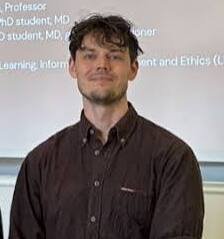
Elias Schriwer, doctoral student at Lifelong Learning in Health Care Contexts
“My project explores patient involvement in health professions education, which is when someone with a unique experience of sickness symptoms or healthcare is involved in education with the primary aim of educating. What stands out is that it highlights a revolution (or rather renaissance) in what is considered knowledge within the field of medical research and education, where lived experience as an expertise is being integrated more into education.”
Tell us a bit about yourself and your background. What did you do before you started your doctoral studies?
To keep a life story slightly relevant for the context, after graduating from high school I spent a year and a half working and backpacking South America before I started studying. At the time I was stressed about starting, feeling like I was late into university, which of course was stupid. One great thing about Sweden is that you can enroll in studies basically all your life, and being stressed at 20 was probably not necessary. However, I’ve never regretted starting medical school, it was a great time, meeting great people, learning and experiencing incredibly much. Parallel to medical studies, I started teaching anatomy, which I continued to do throughout my studies. However, medical school, working jobs and having a personal life took its toll and the transition from university studies to work life sent me over the edge, into a burnout. I took a step back and, while recovering, contemplated what I wanted to do with my life.
How did you become interested in doing research and what made you want to be a doctoral student at our department LIME?
After thinking about what I wanted to do, I figured that I wanted to work with education in some sense, and that the process of publishing my thesis from medical school made me interested in pursuing research. And then, after keeping my eyes open for a few months, there was an ad for a PhD-project in medical education at the KI website. It felt almost too suitable, so I naturally applied, and luckily, I got it.
As previously mentioned, it was more luck that brought me to LIME. I knew that there was research going on that interested me, but it wasn’t really until I applied for the PhD-position that I felt that it was the right place to be for me, and that feeling has just intensified.
If you were to describe your current doctoral research project in one or two sentences for a class of eight-year-olds, how would you describe it?
I’m exploring how patients with lived experience of sickness, symptoms or health care are involved in health professions education.
Can you tell us about your PhD research project? What makes your research stand out?
My project explores patient involvement in health professions education, which is when someone with a unique experience of sickness symptoms or healthcare is involved in education with the primary aim of educating. What stands out is that it highlights a revolution (or rather renaissance) in what is considered knowledge within the field of medical research and education, where lived experience as an expertise is being integrated more into education. Thus, emphasizing the importance of understanding the subjective perspective of knowledge and reality for health professionals.
What are you working on right now and in the nearest months?
Right now, I’m coming out of a long period of intensive lecturing, which has been fun, but rather exhaustive. The focus of the nearest weeks will be on finishing data collection for my third study and finishing the manuscript of my second. Plus, of course, trying to enjoy summer.
What is the best and most interesting part of being a doctoral student?
I love knowledge and learning new things. As a doctoral student, you get a salary from studying, both deep and broad, as well as contributing to new knowledge and spreading what you know. All this in an environment that fosters and promotes knowledge. Incredible.
Can you describe the challenges (if any) in being a student at doctoral level?
It’s difficult, demanding both effort and time, progress is slow at times and it’s easy to lose hope and sense of direction during stressful or challenging periods. When working individually on such a large project, it’s easy to feel that you and your PhD-project become one. Then, challenging periods become almost personal, which can be difficult to handle. Just remember, the project is not you, it’s just a PhD-project, and you’re never alone.
What is your relationship with other doctoral students like?
I try to, but I’m probably not a role model for those wanting to network more. I have friends and acquaintances, but it would be fun to do more!
What do you like to do when you are not doing research?
Probably the same as most people, hanging out with friends, family. I work out frequently and love to cook. I’ve had more specific hobbies before, but right now I’m thankful for and fulfilled with life on a day-to-day basis
What do you envision yourself doing after graduation?
That’s the big question, isn’t it? There are probably a thousand things I would like to do, but who knows? I’m less of a “10-year plan”-person and more of a “life happens”-person. So, the short answer is: I have no idea, but I look forward to it.
Do you have any advice for someone thinking about applying for doctoral studies?
It’s easy to just say “Do it!” or something like that. However, a PhD is demanding, and the highest academic degree in Sweden, so it shouldn’t be taken lightly. But if you’re interested in the subject and could see yourself pursuing a career in that specific research field, academia or somewhere related, do it!
Anything else you want to say?
No, I just hope this is of interest to someone.
Name: Elias Schriwer
Age: 30
Born: Stockholm, born and raised.
Educational background: Medical degree from Karolinska Institutet
Date for start of doctoral studies: November 2023
Title of PhD project: Learning with patients – patient involvement in education
Employment: Employed doctoral student at Karolinska Institutet