
About the Centre for Health Crises
In an era of complex health crises, such as conflicts, climate change and global pandemics there is a need for accessible knowledge. We argue that the expertise and capacity of universities, when it comes to research, education and collaboration can used better, to benefit society. Supported by our organisational set up, our strategic goals, our areas of expertise and our networks, we make health crisis expertise accessible, develop educational initiatives and create forums for discussion.

About the Centre
The Centre for Health Crises was established in the aftermath of the COVID-19 pandemic, with the intention to be a platform for gathering knowledge about acute health emergencies and pandemics. Just as the Centre was launching its operations, the full-scale invasion of Ukraine took place. It made it clear that it was important to address health crises from a broader perspective, beyond just disease outbreaks. Since then, we have combined a long-term focus on preparedness with an ability to respond to urgent needs that arise in a health crisis. Our aims are to:
- Make health crisis expertise found at Swedish and Nordic universities accessible, along with clinical and practical experience of working health crises nationally and internationally, with the aim of creating a cognitive infrastructure that can provide useful support before, during and after a health crisis.
- Mobilise and develop education for the healthcare sector and others, that trains people in how to manage health threats and work with limited resources and information. By doing so, we aim to contribute to the development of necessary skills, which needs to happen before a crisis occurs.
- Be an independent forum for discussion on complex issues that require expertise and experience to consider different needs and discuss conflicting objectives. Thereby, we preserve the universities’ vital role as pillars of society, as well as independent and credible sources of knowledge in times of crisis and conflict.
Our vision
A society better prepared for future health crises.
Our mission
Drive the advancement of knowledge-based health crisis preparedness.
Our strategic goals
To achieve our vision and fulfil our mission, we have set five strategic objectives for our organisation:
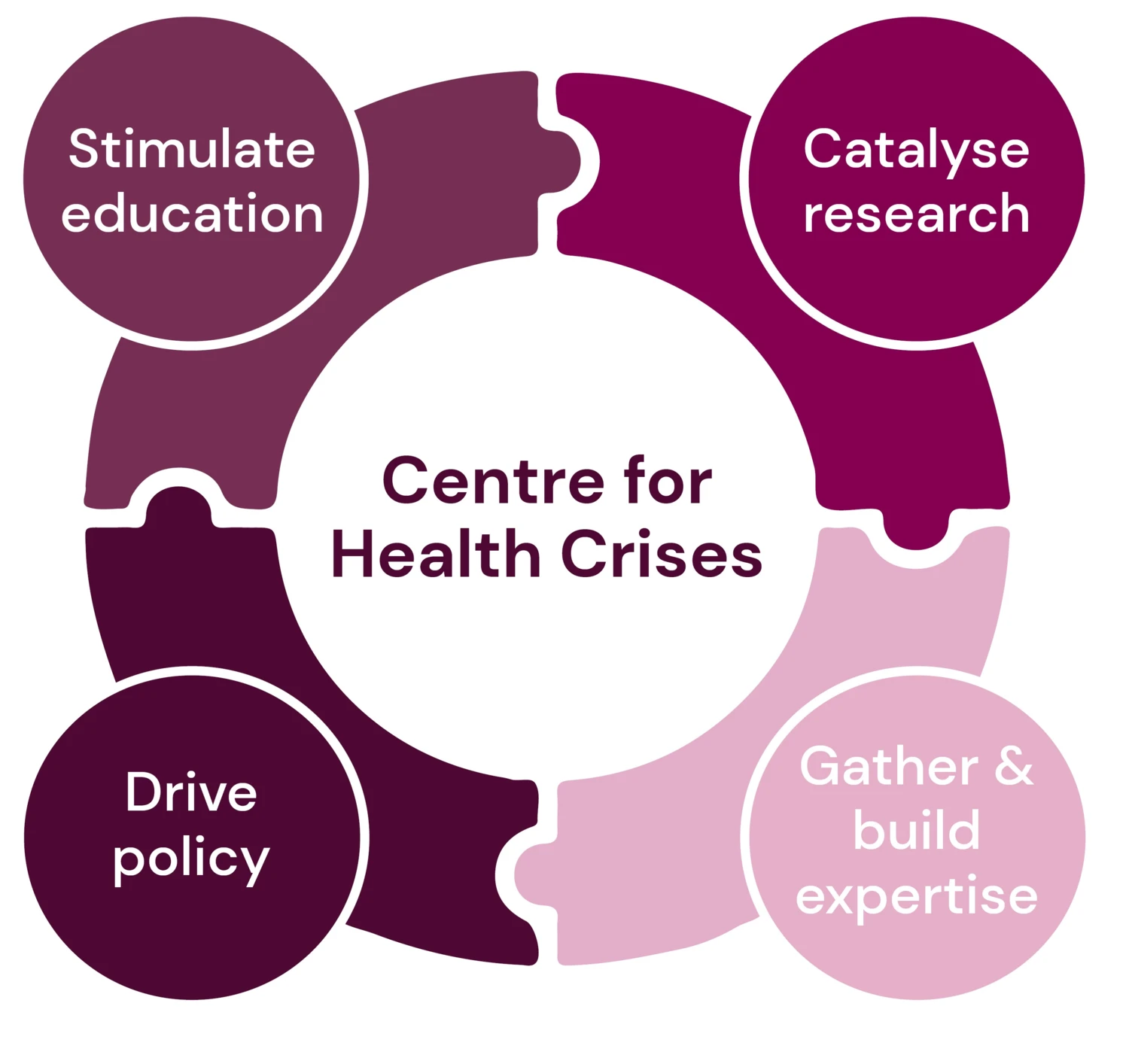
- Catalyse research collaborations within the field of health crises and create meeting spaces for interdisciplinary collaboration
- Stimulate and participate in the development of new education within different health crises subjects
- Gather existing and build new health crises expertise, and supply specific know-how and competence
- Drive policy development and in collaboration, set the agenda for increased health crises preparedness
- Act as KI’s and its managements sensor for new health threats, and contribute to the coordination of KI’s efforts in a health crisis
Our definition of health crisis
We define health crisis as: A hazardous disruption that causes significant effects on human health and that risks exceeding the health system’s ability to cope.
The emergence of a health crisis, as well as its scale and severity, is determined by the disruption or threat, as well as the vulnerability of individuals and the health system, and the extent of exposure in a given situation. We understand health crises from an ‘all hazards’ perspective; that is to say, although health threats may have different origins (natural or man-made), they often affect health systems in similar ways and require a multi-sectoral response. Furthermore, we believe that a common aspect of health crises is the need for surge capacity – the ability to scale up and adapt operations.
Our areas of expertise
Our areas of expertise reflect our interdisciplinary work method. Thanks to close collaboration between these areas, we are able to link trends, solutions and working methods that are relevant to health crises in general. Moreover, we place great importance on ensuring we maintain a connection link to clinical and practical work within each area of expertise. An example of this is how our expert coordinators, in addition to their roles at the Centre, are either clinically active within the healthcare sector or work as researchers.
- Emergency surgery
The generalist expertise and skills found in emergency and trauma surgery are particularly important during a health crisis, when needs always exceed available resources.
Expert coordinator: Lisa Strömmer - Extreme weather, climate and health effects
Climate change and more frequent extreme weather events – such as heatwaves, droughts, cold spells, etc. – pose serious health threats, which can both trigger health crises in their own right and exacerbate others.
Expert coordinator: Petter Ljungman - Health system resilience
The vulnerability of a health system, both for the individual and for society, determines its ability to prepare for, manage and learn from a crisis. Building and maintaining robust and resilient health systems is crucial for managing health crises.
Expert coordinator: Helena Nordenstedt - Infectious diseases and vaccine preparedness
Infectious diseases can lead to serious health crises. Vaccines are a key element of preparedness, as are the effective management of cases and the roll-out of vaccination programmes once a crisis has arisen.
Expert coordinator: Helena Hervius Askling - Critical care with limited resources
In almost all health crises, regardless of how and why they arise, the need for intensive care for patients increases, whilst the conditions under which it can be provided change. The ability to work with limited resources therefore becomes a key skill.
Expert coordinator: Märit Halmin - Chemical and toxicological events
Accidents and deliberate releases of chemical and toxic substances pose a serious threat to health. Preventing such incidents and managing them appropriately is crucial to health emergency preparedness.
Expert coordinator: Mattias Öberg. - Laboratory and diagnostic surge capacity
Many health crises – ranging from infectious diseases to chemical spills – involve a change in or an increased need for laboratory equipment and diagnostic capacity. Being able to scale up these operations is a key part of health crisis preparedness.
Expert coordinator: Jessica Alm - Mental health preparedness
A comprehensive approach to health crises must also address mental health and psychosocial support, at both the individual and societal levels. To be effective, such support must also take into account the needs and capabilities of different groups.
Expert coordinator: Karima Assel. - Policy and preparedness
Health crises arise within a social and societal context. It determines the level of preparedness, how the crisis is managed and the opportunities to learn from it. We therefore need to understand these structures and how they can be influenced.
Expert coordinator: Maja Fjaestad - Primary care
Primary care is often the form of healthcare that is closest to the people. As such, it plays a central role in maintaining continuity and making the best use of its resources during a crisis. Consequently, it is important that it is included in planning, coordination, development and delivery, both in health crisis preparedness and management.
Expert coordinator: Faraidoun Moradi och Hani Khalifa - Outbreak preparedness and response
Outbreaks of infectious diseases can be difficult, or even impossible, to treat, and by no means can all of them be prevented by vaccination. Preparedness for such outbreaks and knowledge of how to manage them are crucial to preventing a health crisis from escalating.
Expert coordinator: Hedvig Glans
Organisation and office
The day-to-day running of our organisation is structured around an office that consists of: the director, a strategic process manager, an administrative coordinator, a collaboration manager and a communications officer, as well as our expert coordinators.
Furthermore, we have access to additional, extensive expertise in these and other topics relevant to health crises (such as crisis communication, organisation and management, and technology and data) thanks to our networks – the Health Crises Network and the Nordic Health Crises Universities Network.
In organisational terms, the centre is based at the department at KI where the director is employed (currently the Department of Global Public Health). To ensure transparency in relation to that department, the head of department is a member of the centre’s steering group. The centre reports, via the director and the steering group, directly to the President of KI.
The Centre’s office is located at the Department of Global Public Health in the Widerströmska building at KI campus Solna.
Governing documents
In our governing documents you can read more about the Centre’s organisation, mission, plans and previous activities.
Focus and programme areas
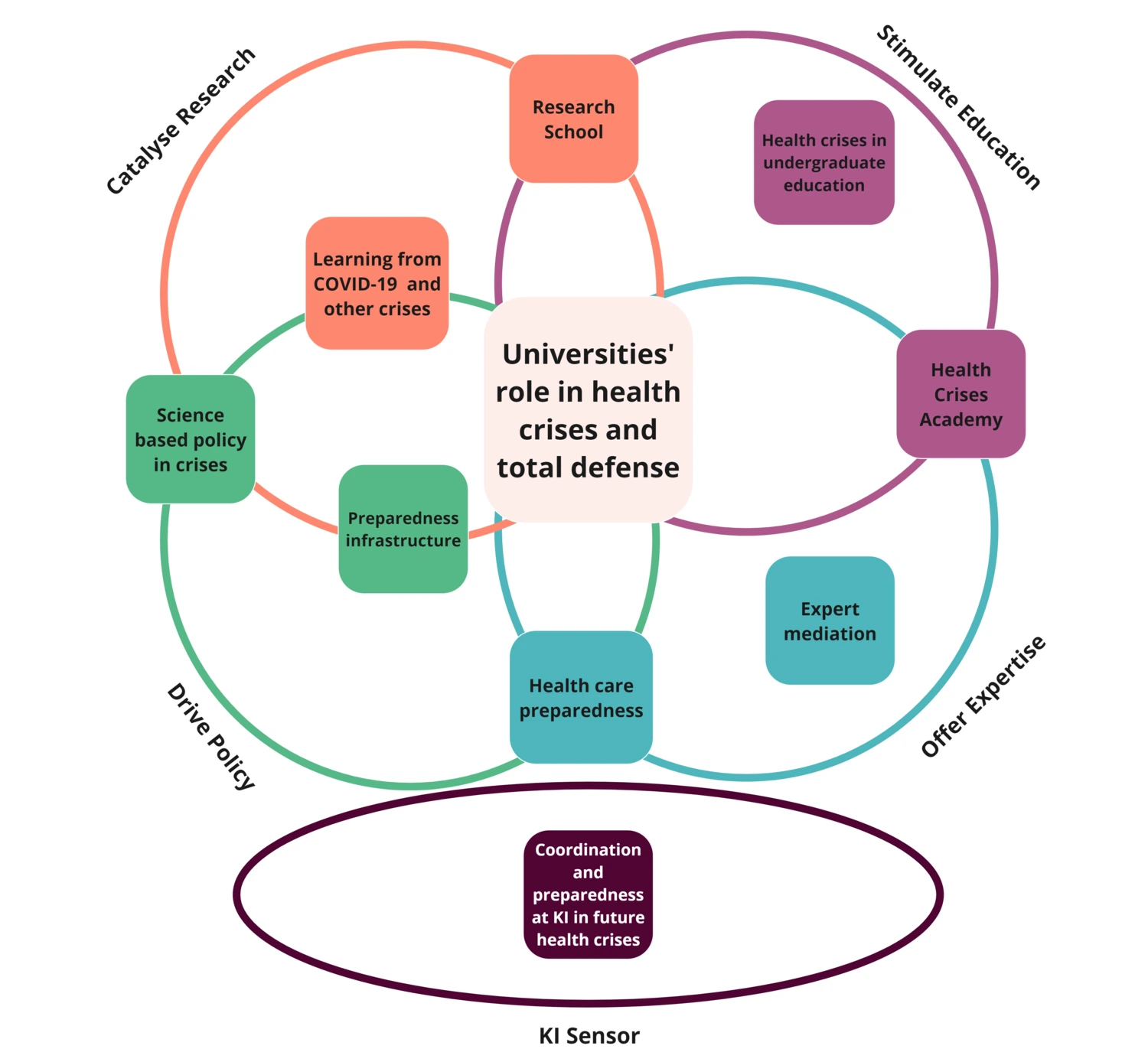
In the 2024–2026 work plan we have chosen to organise our activities around 10 focus areas. We have then grouped some of these into two programme areas: Science to Policy, which focuses on policy development and expert mediation, and the Health Crisis Academy, in which we manage our educational activities.
Steering group
Our Steering Group consists of representatives from several departments at KI, as well as external partners. They ensure that the development of, and work within, the Centre is done in accordance with our mission. They also provide advice and support for the Centre's continued development.
The members of the Steering Group (based at KI, unless otherwise stated) for the period 2025-01-01 to 2027-12-31 are:
- Hans-Gustaf Ljunggren, Department of Medicine, Huddinge (chairman)
- Tobias Alfvén, Department of Global Public Health
- Anna-Mia Ekström, Department of Global Public Health
- Maria Eriksdotter, Department of Neurobiology, Care Sciences and Society
- Marie Hasselberg, Department of Global Public Health, (Head of Department at the Centre's administrative host department)
- Ulrika Widegren, Professional Services KI
- Sebastiaan Meijer, the Royal Technical University - KTH
- Staffan Svärd, Pandemic Laboratory Preparedness, Sci-LifeLab, Uppsala University