

The TINA project - bridging barriers to mental health support for newly arrived minors
Children and adolescents with migrant backgrounds are less likely to access mental health care, despite often having substantial mental health problems. The TINA project (Tidiga Insatser NyAnlända) explored how barriers to care can be reduced through interventions in healthcare, municipalities, and civil society.
Preliminary findings suggest improved knowledge of mental health services and referral pathways among both professionals and parents. The TINA-project appeared to strengthen referral pathways and improve access to mental health support, but the effects were not sustained over time.
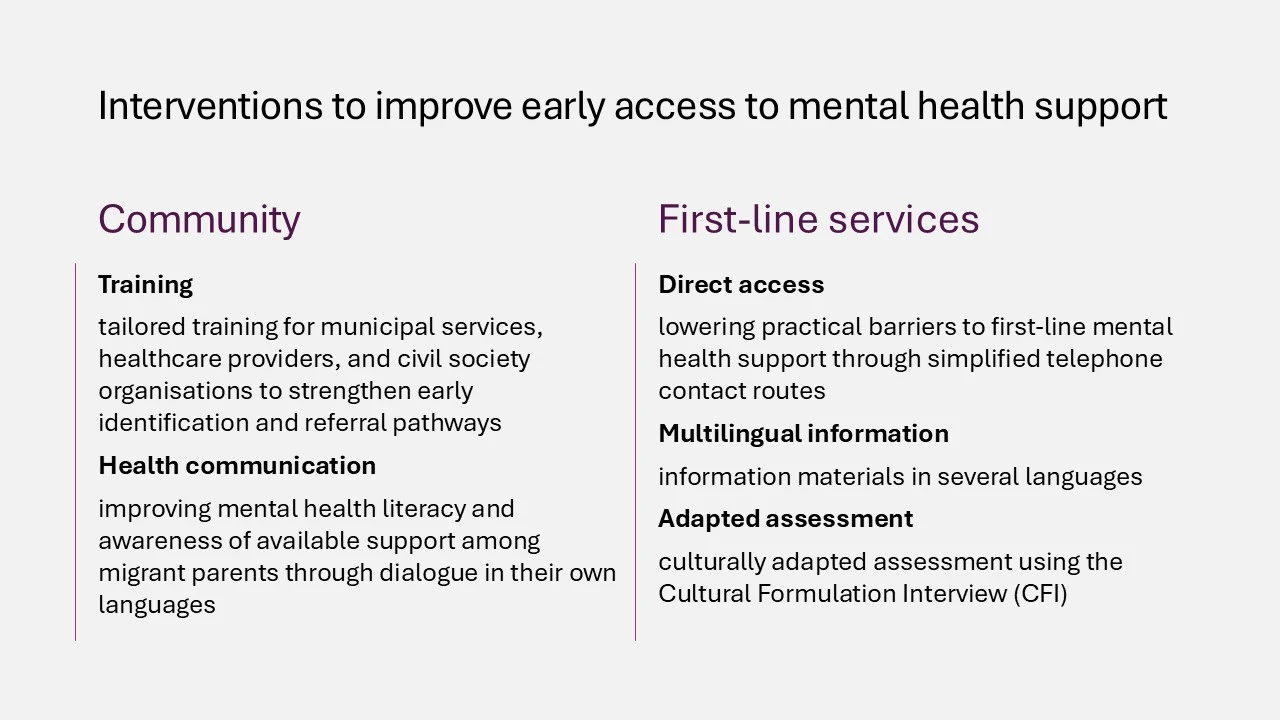
Based in Haninge, Stockholm, the project combined community interventions, and changes within primary care mental health services (“First-line services”) to improve access to care.
The evaluation included quantitative and qualitative methods; Questionnaires and interviews, focusing on both process and effect measures, and finally, we explored whether the number of first-time contacts had increased during a follow-up period of three years, taking advantage of full coverage administrative health care registers.
Preliminary findings suggest that several components of the intervention were feasible and well accepted by participants and collaborating organisations. Increased knowledge of mental health services and referral pathways was observed among both professionals and parents, and the project identified practical measures that appeared to facilitate access to care, including simplified contact routes to primary care mental health services.
The analysis of register data showed a significant increase in first-time contacts among individuals without migrant backgrounds during the first year of the follow-up period, compared to matched controls (IRR 1.3 (95% CI 1.1-1.5). An increase of similar magnitude was found during the same period for individuals with migrant backgrounds, although not statistically significant (IRR 1.3 (95 % CI 0.9-1.8)). No increase in first-time contacts was observed during the last two years of the follow-up period, neither among individuals with or without migrant backgrounds.
The project highlights important challenges related to sustainability. Effects on care-seeking appeared during the initial phase of the intervention, suggesting that continued collaboration through stable organisational structures, and ongoing local engagement may be necessary to maintain impact over time.
Publications
The first thesis within the project
Research components
 Photo: Karima Assel.
The community-based intervention
 Photo: Getty Images
The primary care-based intervention
Project contact person
Christina Dalman
Professor, SeniorInvolved in the project
Co-applicants, expertise
- Sofie Bäärnhielm, director of The Knowledge Centre For Transcultural Psychiatry, Region Stockholm. Role: project leader of the qualitative studies.
- Cécile Rousseau, professor in child- and adolescent psychiatry at McGill University, Canada. Role: Over all expert and experienced in using the cultural formulation interview in clinical practice.
- Aina Vaage, the Centre for Transcultural Psychiatry, Stavanger University Hospital. Role: planning and evaluations of the focus groups interviews, adaption of treatment as usual, training of the staff at site, and over all expertise in building up health care structures targeting migrants.
- Rosaria Galanti, (EPHIR) Department of Global Public Health, KI. Role: project leader of the evaluation part of the project.
- Henna Hasson, (Procome) LIME, KI. Role: project leader of the implementation.
The core working group
- Christina Dalman, PI, consultant, professor in psychiatric epidemiology, EPiCSS Research Group
- Anna-Clara Hollander, PhD, psychologist, researcher, EPiCSS Research Group
- Johan Åhlén, PhD, psychologist, The Unit for Mental Health, Region Stockholm
- Karima Assel, child and adolescent psychiatrists, PhD student, EPiCSS Research Group
- Ana Hagström, Phd student, PROCOME Research Group
- Hanna Johans, project coordinator, EPiCSS Research Group
- Ester Gubi, MD, PhD, EPiCSS Research Group