
About Labmed
The Department of Laboratory Medicine (LABMED) is active in a wide range of areas, from basic research to the development of diagnostic tools, the discovery of biomarkers and advanced treatments (e.g. cell and gene therapy), all of which have a direct impact on human health.
LABMED brings together fundamental biomedical science, clinical (patient-oriented) problems, the development of technical methods and practical application.
In addition to its research mission, LABMED has a strong educational role — it is one of the larger teaching departments at KI and contributes to numerous programmes on undergraduate, graduate and advanced level
A key infrastructure is the Karolinska ATMP Center, co‑organized by Karolinska Institutet and Karolinska University Hospital, integrating research, development, production and clinical application of advanced therapy medicinal products (cell, gene, tissue therapies).
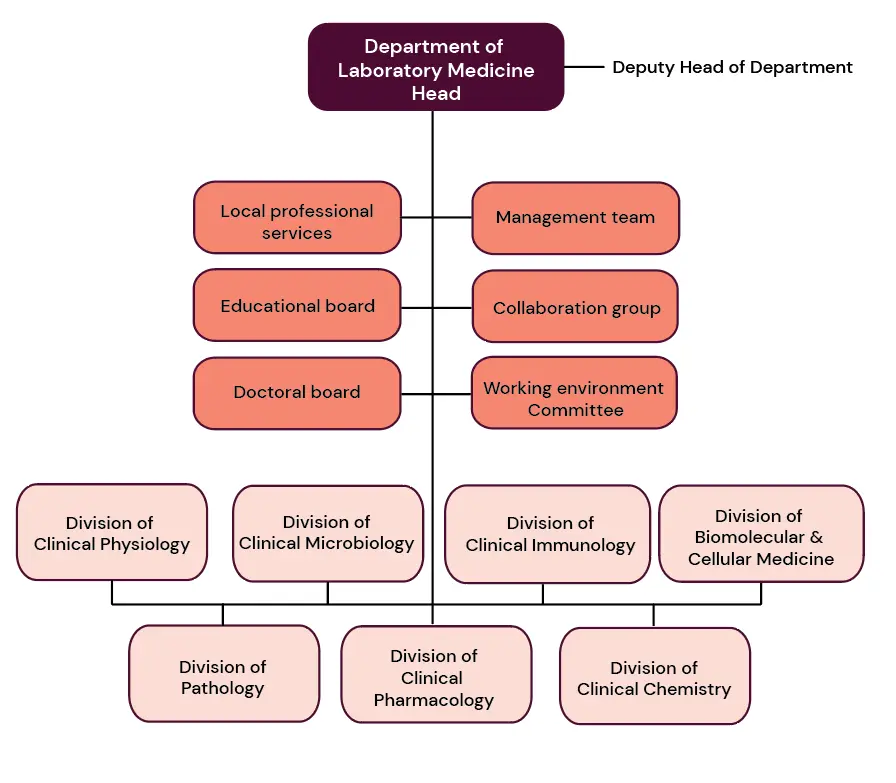
LABMED is organized into seven divisions, each covering distinct but overlapping thematic areas of laboratory medicine and translation.
Focuses on the development and engineering of biomolecules, cellular therapeutics, extracellular vesicles, gene therapy, and molecular targeting.
Specializes in analytical method development, biomarker research, validation of assays, and bridging basic chemistry with clinical translation.
Conducts research on immunity, transplantation, immunogenetics, immunodeficiency, and immune regulation, often in close collaboration with hospital clinical immunology services.
Investigates pathogen biology, molecular diagnostics, antimicrobial resistance, and viral and bacterial pathogenesis, with strong links to clinical diagnostics.
Explores disease mechanisms at tissue, cellular, and molecular levels, integrating histopathology and morphology with molecular pathology.
Examines pharmacokinetics, pharmacogenomics, interindividual variation in drug responses, and biomarkers of drug exposure, contributing to precision medicine.
Studies organ‑system physiology, imaging, functional diagnostics, and integrative physiology, including research within the Human Physiology Laboratory.
Divisions are led by division heads, supported by administrative staff, and manage research, education, and operations. Cross‑divisional units and infrastructures (e.g., core facilities, translational platforms, ATMP infrastructure) foster collaboration across themes and enhance translational impact.
Organisational structure
Vision
The Department will conduct world-leading research and education within the laboratory disciplines represented at the Department. In the next three years, we shall create a translational environment for research and education that attracts – and creates – researchers and students of the highest quality.
The history of the Department
The Department of Laboratory Medicine was established in 2003. Click here if you want to know more. (only in Swedish)