
VIPS: Vaccination in Pregnancy Study
Vaccination during pregnancy is an effective way to protect the mother, the fetus, and the newborn against serious infectious diseases. Protective antibodies are transferred to the baby, providing important protection during the first months of life, when the infant is most vulnerable. This study aims to deepen knowledge about the factors that influence who vaccinates during pregnancy, and how safe and effective the vaccines are.
About the Study
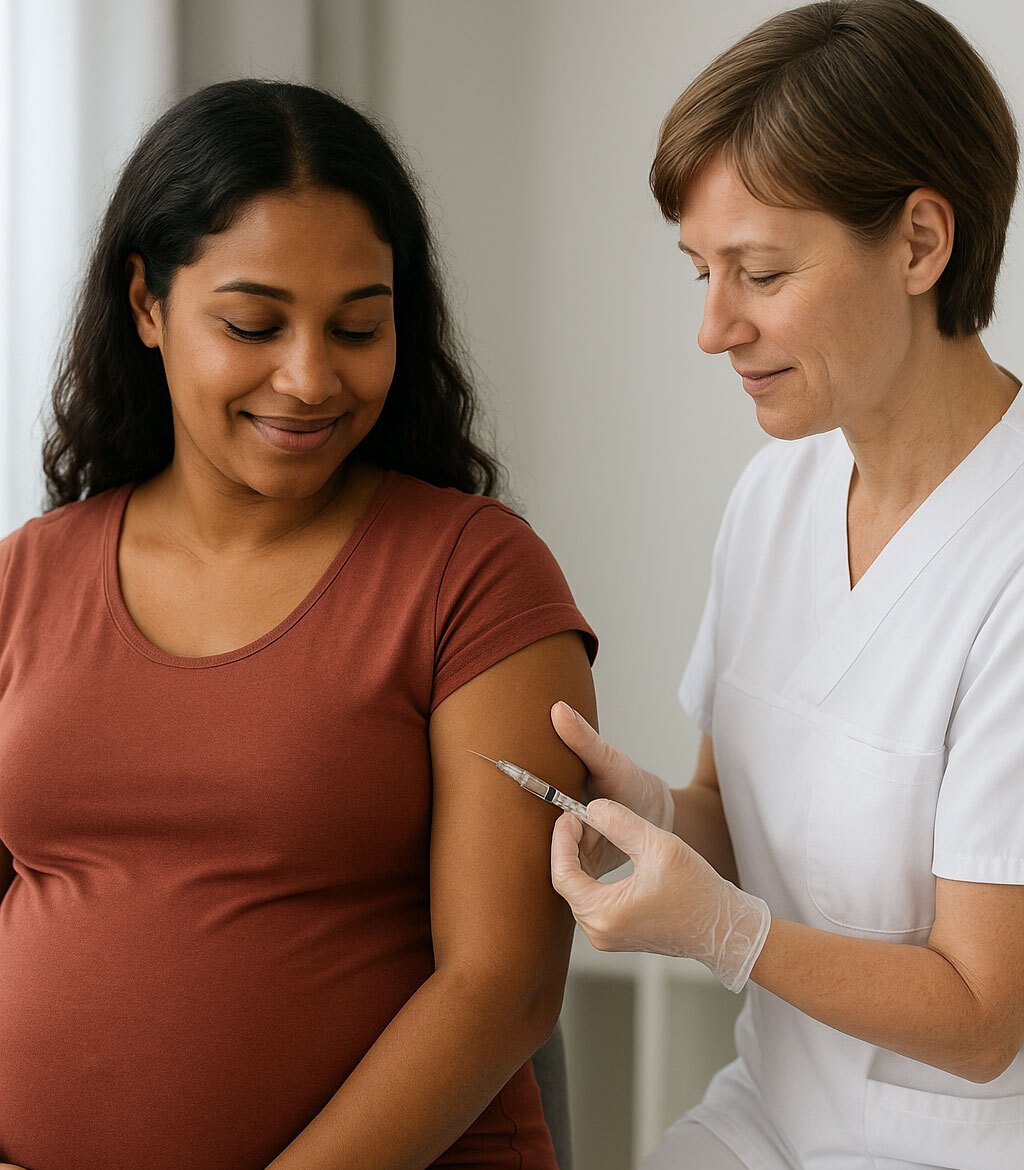
Vaccination in pregnancy is a growing field of research with the potential to prevent severe illness in both pregnant women and infants. In VIPS (Vaccination in Pregnancy Study), we examine how vaccination in pregnancy is perceived by both pregnant women and healthcare providers in Sweden, how many pregnant women have been vaccinated against different diseases, and how safe and effective the vaccines are.
We collect knowledge through interviews, focus group discussions, and analyses of register data. The goal is to contribute to more equitable and evidence-based care for pregnant women and newborns.
Especially Vulnerable to Severe Infections
Pregnant women, fetuses, and newborns are particularly sensitive to infections. During pregnancy, the immune system changes so that the body does not reject the fetus, which can make it harder to fight certain viruses and bacteria. At the same time, physical functions such as breathing and blood flow are affected, which can worsen symptoms during an infection.
Newborn infants have not yet developed a fully functioning immune system, making them especially vulnerable to infections. Examples of infections that can cause severe illness in pregnant women include influenza and COVID-19, while pertussis (whooping cough) and respiratory syncytial virus (RSV) can cause serious disease in infants.
Vaccination in Pregnancy
When a pregnant woman is vaccinated, she develops antibodies against the virus or bacteria that the vaccine targets. These antibodies are then transferred to the baby through the placenta, and after birth, also through the breast milk. The antibodies continue to protect the baby during the first period after birth – a time when the infant is at higher risk of severe illness due to infections.
The Public Health Agency of Sweden currently recommends influenza vaccination for pregnant women during the autumn and winter season, as well as pertussis vaccination year-round, to protect both the pregnant woman and the baby against severe disease. These two vaccinations are offered free of charge to all pregnant women in every region of Sweden.
There is also an RSV vaccine for pregnant women that provides protection to the newborn immediately after birth, but this vaccine is not currently offered free of charge in Sweden. To protect infants against RSV during the autumn and winter season, protective antibodies are offered to all newborns from autumn 2025 onwards.
More information about vaccination in pregnancy and how to receive vaccination in your region can be found on 1177.
VIPS-Q: Key Barriers and Enablers for Vaccination in Pregnancy in Sweden
This qualitative part of the study consists of two sub-studies and aims to increase the understanding of how pregnant women and healthcare professionals reason about vaccination in pregnancy. The study examines which factors influence the decision to accept or decline vaccination, and the role of information, communication, and practical aspects such as accessibility and convenience.
Sub-study 1
How do pregnant women in Sweden perceive vaccination during pregnancy, and what are the key barriers and enablers they experience?
We conduct interviews with women 3–12 months after giving birth. The aim is to better understand how women perceive vaccination during pregnancy – both the most important barriers and the most significant enabling factors.
Recruitment for sub-study 1 is now closed and data analysis is underway.
Sub-study 2
How do healthcare providers experience and perceive vaccination during pregnancy, and what is their role in managing hesitancy and facilitating acceptance?
We conduct group discussions and interviews with midwives and physicians within maternal healthcare. The aim is to understand better how vaccination during pregnancy is organized and implemented, how information is communicated and received, and what attitudes and perceptions exist among pregnant women and healthcare professionals. We also seek to highlight factors that influence access to vaccination and gather suggestions on how recommendations and communication efforts to both pregnant women and healthcare providers can be improved.
Frequently Asked Questions About Vaccination in Pregnancy
Vaccines stimulate the adaptive immune system to produce antibodies and immunological memory against specific viruses and bacteria, without causing illness. During pregnancy, vaccination not only protects the pregnant woman, but also enables the transfer of antibodies to the fetus through the placenta. This passive immunity can protect the newborn during the first months of life.
Pregnancy causes natural changes in the immune system, cardiovascular system, and lung function. These changes are necessary but can increase the risk of severe complications from certain infections, such as influenza. Vaccination during pregnancy is recommended to reduce the risk of severe illness and complications in the pregnant woman, including preterm birth and reduced fetal growth. The vaccination also leads to protective antibodies being transferred to the fetus, reducing the child’s risk of severe infection during its first months of life.
The vaccines recommended during pregnancy in Sweden have undergone thorough safety evaluations and are approved by the European Medicines Agency and the Swedish Medical Products Agency. Data from clinical trials and large observational studies show that these vaccines are safe for mothers, fetuses, and newborns. Mild side effects – such as soreness at the injection site or mild fever – are common, but serious adverse events are very rare. There is no scientific evidence that vaccination during pregnancy increases the risk of miscarriage, birth defects, or other negative pregnancy outcomes. Consultation with a midwife or doctor is recommended for individual concerns.
More information about vaccines recommended during pregnancy can be found on the Public Health Agency of Sweden’s website and 1177.
The Research Team
We are a group of physicians, midwives, nurses, and public health researchers working together.
Principal investigator:
Anne Örtqvist is a specialist in obstetrics and gynecology and an associate professor in clinical epidemiology at Karolinska Institutet. In her clinical work, she meets pregnant women daily, many of whom have questions about the benefits and risks of vaccination during pregnancy.
Anne Örtqvist
Responsible researcher (Principal Investigator) for VIPSKevin Lasmi
Doktorand, sjuksköterska, MSc Global hälsa.Hanna Josefsson
Doktorand, MSc Folkhälsovetenskap.Olof Stephansson
Professor, överläkare inom obstetrik och gynekologi.Helena Hervius Askling
Docent, överläkare inom infektionsmedicin med särskild vaccinexpertis.Carolyn Cesta
Docent, biträdande lektor i farmakoepidemiologi.Louise Lundborg
Postdoc, PhD, barnmorska.Karin Johnson
Doktorand, barnmorska.Related Publications
COVID-19 vaccination in pregnant women in Sweden and Norway.
Örtqvist AK, Dahlqwist E, Magnus MC, Ljung R, Jonsson J, Aronsson B, Pasternak B, Håberg SE, Stephansson O
Vaccine 2022 Aug;40(33):4686-4692
Covid-19 vaccination and menstrual bleeding disturbances among women of fertile age: a Norwegian registry study.
Magnus MC, Caspersen IH, Wensaas KA, Eide HN, Örtqvist AK, Oakley L, Magnus P, Håberg SE
Eur J Epidemiol 2024 Oct;39(10):1127-1138
Association of SARS-CoV-2 Vaccination During Pregnancy With Pregnancy Outcomes.
Magnus MC, Örtqvist AK, Dahlqwist E, Ljung R, Skår F, Oakley L, Macsali F, Pasternak B, Gjessing HK, Håberg SE, Stephansson O
JAMA 2022 Apr;327(15):1469-1477
COVID-19 vaccination during pregnancy is not associated with an increased risk of severe postpartum hemorrhage.
Magnus MC, Rasmussen TD, Örtqvist AK, Oakley LL, Urhoj SK, Stephansson O, Håberg SE
Am J Obstet Gynecol 2024 Sep;231(3):e99-e100
Neonatal Outcomes After COVID-19 Vaccination in Pregnancy.
Norman M, Magnus MC, Söderling J, Juliusson PB, Navér L, Örtqvist AK, Håberg S, Stephansson O
JAMA 2024 Feb;331(5):396-407