

Human primordial germ cells (hPGCs), the embryonic precursors of sperm and eggs, are specified in the early post-implantation embryo. Subsequently, hPGCs migrate through the primitive hindgut and dorsal mesentery into the developing gonads. After sex determination, hPGCs start to differentiate into gonocytes or oogonia in the developing testis or ovary, respectively. During this early developmental journey, hPGCs experience several selection checkpoints, which are fundamental to choosing the most suitable germ cells to pass the genetic and epigenetic information to the next generations.
Our investigations converge on hPGC early development, which mainly occurs during a window of human embryonic development that we have limited access to study in vivo. To overcome these restrictions, we utilize human pluripotent stem cells and organoid cultures to model these early stages of development. Understanding the principles of hPGC specification, migration, and gonadal colonization will help us to identify the mechanisms driving some cases of infertility and the occurrence of germ cell tumours. Importantly, this knowledge will pave the way for developing efficient protocols for in vitro gametogenesis.
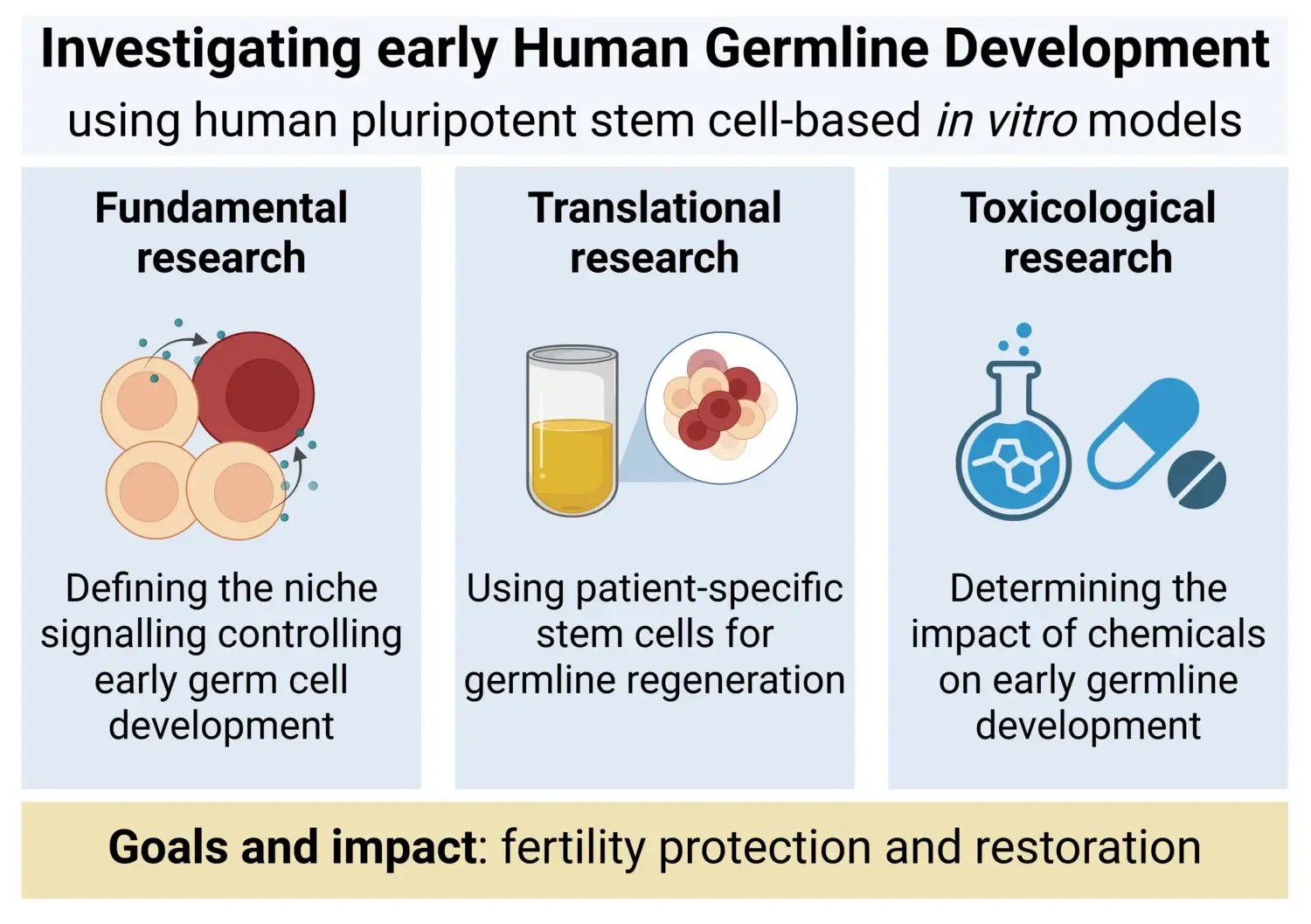
Our research is structured in three main pillars of investigation:
[1] Fundamental research: We use stem cell-derived embryonic models to define niche signalling controlling early human germ cell specification and maturation.
[2] Translational research: We aim to translate fundamental insights from pillar 1 research into strategies for safeguarding and restoring fertility. In this context, we recently generated human induced pluripotent stem cells (hiPSCs) from cryopreserved testicular somatic cells of infertile childhood cancer patients using a non‑integrating mRNA‑based approach. These patient‑specific hiPSCs differentiate into germ cells in vitro, providing the first proof‑of‑concept for stem cell-based fertility restoration in this patient group. Ongoing work focuses on maturation and functional validation of patient‑specific in vitro-derived germ cells.
[3] Developmental and reproductive toxicology research: Using our stem cell-derived embryonic models, we investigate how environmental pollutants and therapeutic drugs disrupt early human embryonic and germline development, which remains largely unexplored.