
The aICU research programme: Developing and evaluating AI-based decision support for intensive care
aICU is a clinically embedded research programme founded at Karolinska Institutet and Stockholm South General Hospital that develops and evaluates AI-based decision support for intensive care.
About the aICU programme
Our work spans retrospective model development, external validation, human-centred design and evaluation, and prospective clinical studies. The programme is supported by large-scale longitudinal ICU data from multiple countries and close integration with the clinical environment in Stockholm. Our aim is to develop systems that are clinically relevant and reliable across patients and settings, and rigorously evaluate their safety and performance before they influence patient care.
The programme’s first major clinical application is decision support around mechanical ventilation and extubation, including dynamic prediction of ventilation duration and extubation failure. The methods, infrastructure and evaluation framework are designed to support research across other complex and time-sensitive decisions in intensive care.
Collaborations
The programme is led from Karolinska Institutet and Stockholm South General Hospital and developed through active national and international research collaborations involving joint projects, supervision and research exchange across institutions.
The programme’s international collaborations began with the University of Cambridge, where we work closely with the ML@CL group led by Professors Neil Lawrence and Carl Henrik Ek in the Department of Computer Science and Technology. At the University of Edinburgh, we collaborate with the groups of Professor Ajitha Rajan in the School of Informatics and Professor Frauke Zeller at the Institute for Design Informatics. Alongside these collaborations, additional national and international partners contribute across individual projects.
Funding and support
The aICU programme has received funding and support from Karolinska Institutet and Södersjukhuset, the University of Cambridge Accelerate Programme for Scientific Discovery, the Region Stockholm Innovation Fund, Digital Futures, the Swedish Association for Anaesthesia and Intensive Care (SFAI) through the Surgery and Intensive Care Research Fund, the Swedish Medical Society (SLS), the Olof Norlander Foundation, the Hirsch Foundation and the Lars Hierta Memorial Foundation.
News from aICU
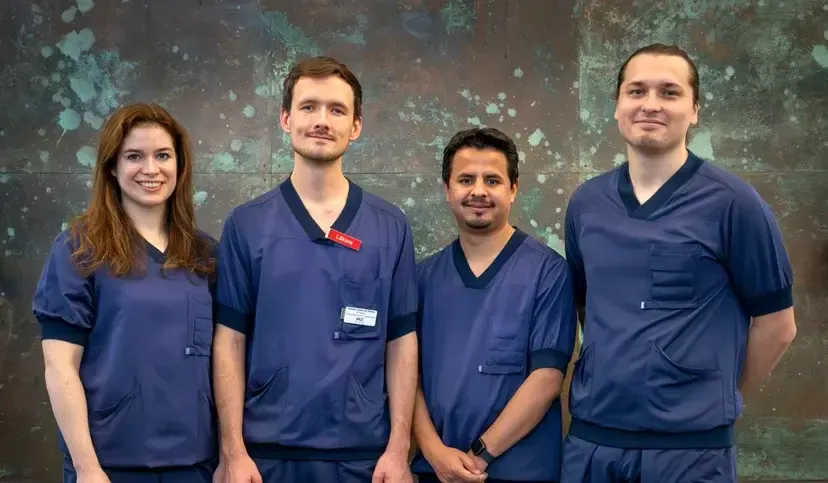 Photo: Fotogruppen Södersjukhuset
Södersjukhuset: Better decision-making support for intensive care with AI assistance
Can artificial intelligence (AI) improve healthcare and save lives? That is the view of Villiam Kildal, who is leading a research project into how AI and machine learning can help healthcare staff in intensive care units make difficult decisions. (In Swedish)
 Photo: N/A
How can we… use AI to support clinical decision-making in intensive care?
Blogpost by PI Villiam V. Kildal for the The Accelerate Programme for Scientific Discovery, University of Cambridge.