

HEATWISE Sweden
Vulnerability of buildings in a changing climate: Indoor heat exposure and public health
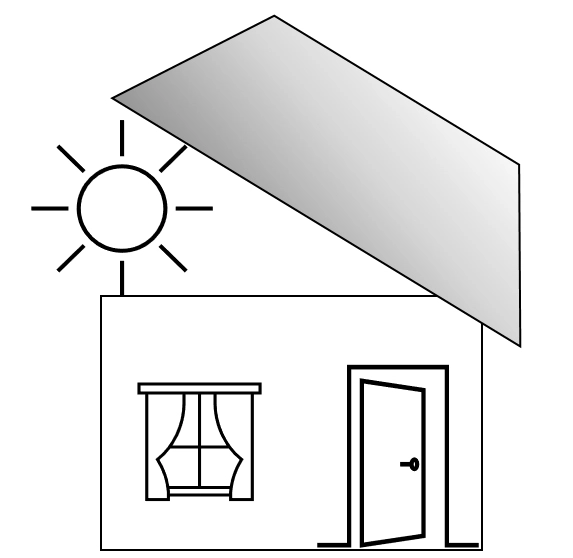
Climate change is responsible for both rising average temperatures and more heat waves. The scientific knowledge about the effects of heat waves on public health is extensive, and many studies show that high outdoor temperatures are associated with increased mortality and morbidity. Heat can affect everyone, but certain groups of the population are particularly vulnerable, including the elderly, those with chronic conditions, people with disabilities, young children, pregnant women and people who use certain medications.
Despite the extensive knowledge about the links between heat waves and ill health, knowledge remains limited regarding how high indoor temperatures affects health in Swedish homes during hot periods. As the number of heat waves increases, it is important to understand which types of housing in Sweden are particularly sensitive to heat and why. Furthermore, there is currently no clear scientific basis to determine at what indoor temperatures discomfort and ill health symptoms, such as sleep disturbances, fatigue or headaches, begin to occur. This knowledge is essential for informing government policy that ensure a healthy indoor climate in future housing, even during hot summers.
The scientific purpose of the study
The purpose of HEATWISE Sweden is to:
- Create evidence-based recommendations for an upper limit for indoor temperature in relation to well-being
- Identify which building and environmental factors that most strongly contribute to unhealthy indoor temperatures during heat waves
- Develop a model for calculating indoor temperature based on outdoor conditions and housing type
- Develop a method for visualising the vulnerability of buildings to heat on an interactive map
Do you want to participate in the study?
To gather the necessary knowledge, we are recruiting participants for HEATWISE Sweden for the summers of 2024–2027. The third season of the study will soon start - summer 2026. You can participate if you:
- are between 30 and 85 years old
- live in Stockholm, Uppsala, Malmö, Lund, Gothenburg or Umeå or the surrounding area
- own a smartphone
- are interested in contributing to research on climate and health

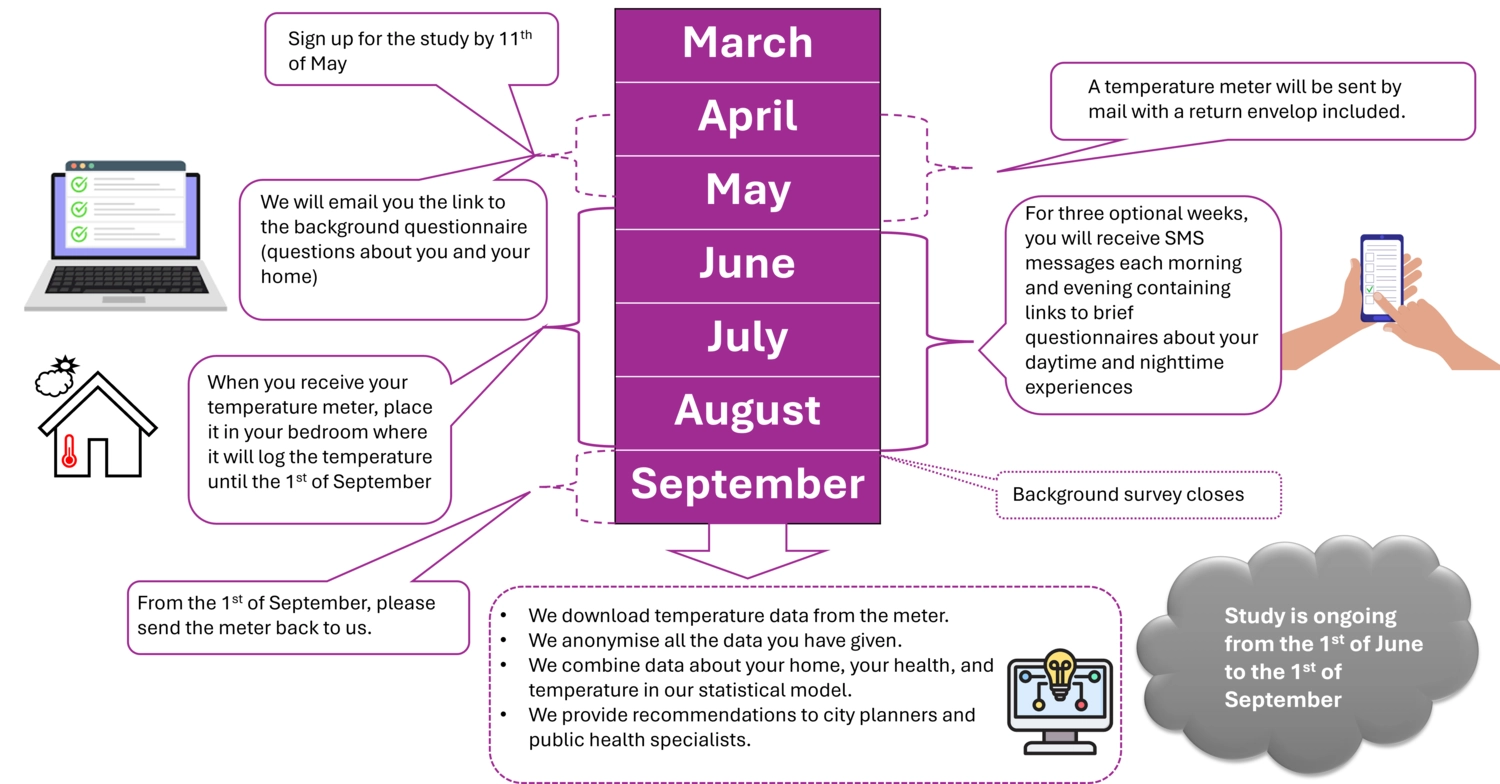
Sign up by clicking on the link: www.redcap.link/heatwise2026.se or scan the QR code with your mobile camera. You will be asked to answer a few short questions that will determine whether the study is suitable for you. A message is given directly on the screen, and it takes about a minute to respond. If you have any questions, you are welcome to contact us via heatwise-imm@ki.se.
Your participation – step by step
HEATWISE Sweden is a collaborative project between Karolinska Institutet, the Centre for Occupational and Environmental Medicine, Stockholm University, KTH Royal Institute of Technology, and the universities of Umeå, Gothenburg and Lund.
How is the study conducted?
During the summers of 2024–2027, we will collect data from a total of 4000 adult volunteer study participants in Stockholm, Uppsala, Malmö, Lund, Gothenburg and Umeå. The data collection includes continuous measurements of indoor temperature and humidity, detailed information about the characteristics of the home, and self-reported health and sleep. After the data collection, statistical analyses are carried out and a model for indoor temperatures is developed.
Recruitment of study participants
Participants are recruited first and foremost through a random selection of people between the ages of 30 and 85 from the Swedish National Personal Address Register, but also through spontaneous registration here www.redcap.link/heatwise2026.se Written invitations are sent out in April each year 2024–2027.
Collection of data on the background and housing of the study participant
As a participant, you will be asked to answer a web-based survey.
The survey consists of several parts:
1. Background information
The first part asks questions about background, such as:
- country of birth
- marital status
- income
- profession
2. Health and lifestyle
The second part includes questions about:
- general Health
- lifestyle
3. Information about the apartment and the residential area
The third part concerns your home and the area where you live. Here we ask questions about, among other things:
- address of the apartment
- housing type
- living space
- year of construction
- floor plan
- type of ventilation
- building materials
- location of the bedroom (orientation)
- size of the windows
- headroom
- number of people living in the apartment
It is common not to know all the details about your home. If you don't know the answer to a question and don't have the opportunity to find out, you can always choose the "I don't know" answer option. If you wish, you can read our checklist with housing questions in advance, which can be found at the bottom of the page under "Information for participants in the study".
Indoor temperature measurement
All participants will receive a temperature and humidity meter before June 1. The participant does not need to do anything to start the meter, it is already pre-programmed. The meter is placed in the bedroom according to clear instructions and records data continuously between June 1 and August 31. In short, the meter is placed in the bedroom in an opaque mug, at a height of 0.5 – 1.7 meters (about the height of a bedside table), in a place where it is not exposed to direct sunlight.
Collection of health and sleep data via short daily questions
Part of the study consists of health reporting, where the participant answers short questions twice a day, in the morning and in the evening. The health reporting takes place for three optional weeks between 1 June and 31 August. The weeks do not have to be consecutive.
What are the questions about?
The questions concern the participants:
- perceived sleep quality
- mental and physical health
- experience of the indoor temperature in the home
How are the questions answered?
- The questions are accessed via a link that is sent to the participant via text message, morning and evening during the selected weeks.
- Answering the questions takes a maximum of five minutes per occasion
How are the responses collected?
The responses are collected via BASS, a secure web-based platform for data collection. The platform uses advanced technology and encrypts all responses. BASS has been specifically developed for scientific data collection and is used in several research projects at Karolinska Institutet.
Choice of reporting weeks
When enrolling in the study, the participant indicates the desired weeks for health reporting. The weeks do not have to be consecutive but are chosen based on when the participant sleeps and stays in the home where the temperature meter is located. If more than three weeks are indicated, a random selection of three weeks is made from the selected weeks. It is of course possible to change selected reporting weeks, if necessary, even during the summer.
Information for study participants
Contact
E-mail: heatwise-imm@ki.se
Marie Flyckt +46 8 524 875 99
Johan Ohlander +46 8 524 875 33
Ashtyn Tracey Areal +46 8 524 875 63 (English)
Project responsible: Associate Professor Mare Löhmus Sundström
Address: IMM, Box 210, 171 77 Stockholm