

Targeting TRAP-driven tumor progression
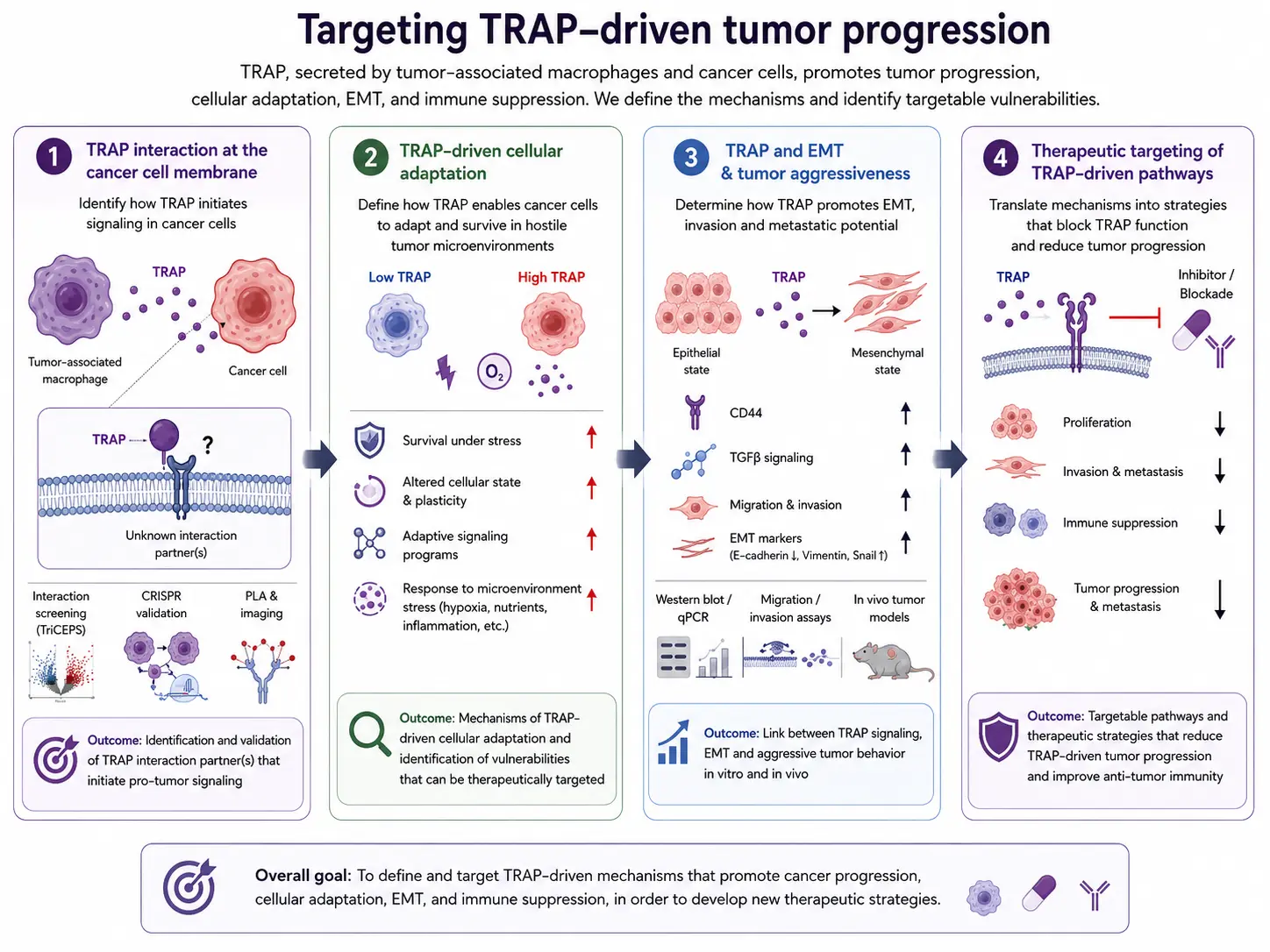
Tumor-associated macrophages and cancer cells release soluble factors that can promote tumor growth, survival and invasion. In this research line, we focus on tartrate-resistant acid phosphatase, TRAP, a secreted enzyme expressed by cancer cells and cells in the tumor microenvironment, including tumor-infiltrating macrophages. TRAP has been linked to cancer-cell proliferation, migration, invasion, poor prognosis, metabolic reprogramming and epithelial-to-mesenchymal transition, EMT.
Our goal is to define how TRAP interacts with cancer cells, how it rewires tumor-cell behavior under stress, and how TRAP-driven pathways can be therapeutically targeted.
Project I
Defining TRAP interaction partners at the cancer-cell membrane
This project investigates how TRAP initiates signaling in cancer cells. Our preliminary data suggest that TRAP binds to the plasma membrane of cancer cells, indicating that one or more membrane-associated interaction partners may mediate its tumor-promoting effects. We aim to identify and validate these TRAP interaction partners using receptor-identification approaches, CRISPR-based validation, proximity ligation assays and advanced imaging. The long-term goal is to uncover the first molecular step in TRAP-driven tumor progression and define new therapeutic targets.
Project II
TRAP-driven metabolic reprogramming and tumor-cell survival
This project examines how TRAP changes cancer-cell metabolism and supports tumor-cell survival under nutrient-deprived and hypoxic conditions. Preliminary findings indicate that TRAP-overexpressing cancer cells show altered glucose uptake, a shift toward pyruvate-dependent oxidative metabolism and increased survival despite metabolic stress.
We use metabolomics, Seahorse analysis, stable isotope tracing and pathway mapping to define how TRAP rewires cancer-cell metabolism. The goal is to identify metabolic vulnerabilities that can be targeted to reduce TRAP-driven tumor growth and survival.
Project III
TRAP, EMT and aggressive tumor progression
This project focuses on how TRAP contributes to epithelial-to-mesenchymal transition, EMT, invasion and metastatic potential. TRAP has been linked to upregulation of CD44 and TGFβ signaling, both of which are associated with aggressive cancer-cell behavior.
We investigate how TRAP-regulated signaling and metabolism influence EMT markers, migration, invasion and tumor progression in vitro and in vivo. The aim is to determine whether blocking TRAP-associated pathways can suppress aggressive tumor phenotypes.
Project IV
Therapeutic targeting of TRAP-driven pathways
This project translates mechanistic findings into therapeutic strategies. Validated TRAP interaction partners and metabolic or EMT-associated pathways will be tested as candidate targets using genetic and pharmacological approaches.
By combining in vitro models, CRISPR perturbation and in vivo tumor models, we aim to identify strategies that block TRAP-driven tumor progression. The long-term goal is to develop therapeutic approaches that reduce tumor growth, metabolic adaptation, invasion and immune suppression.