

Research line II: Adaptive NK-cell memory for solid tumor immunotherapy
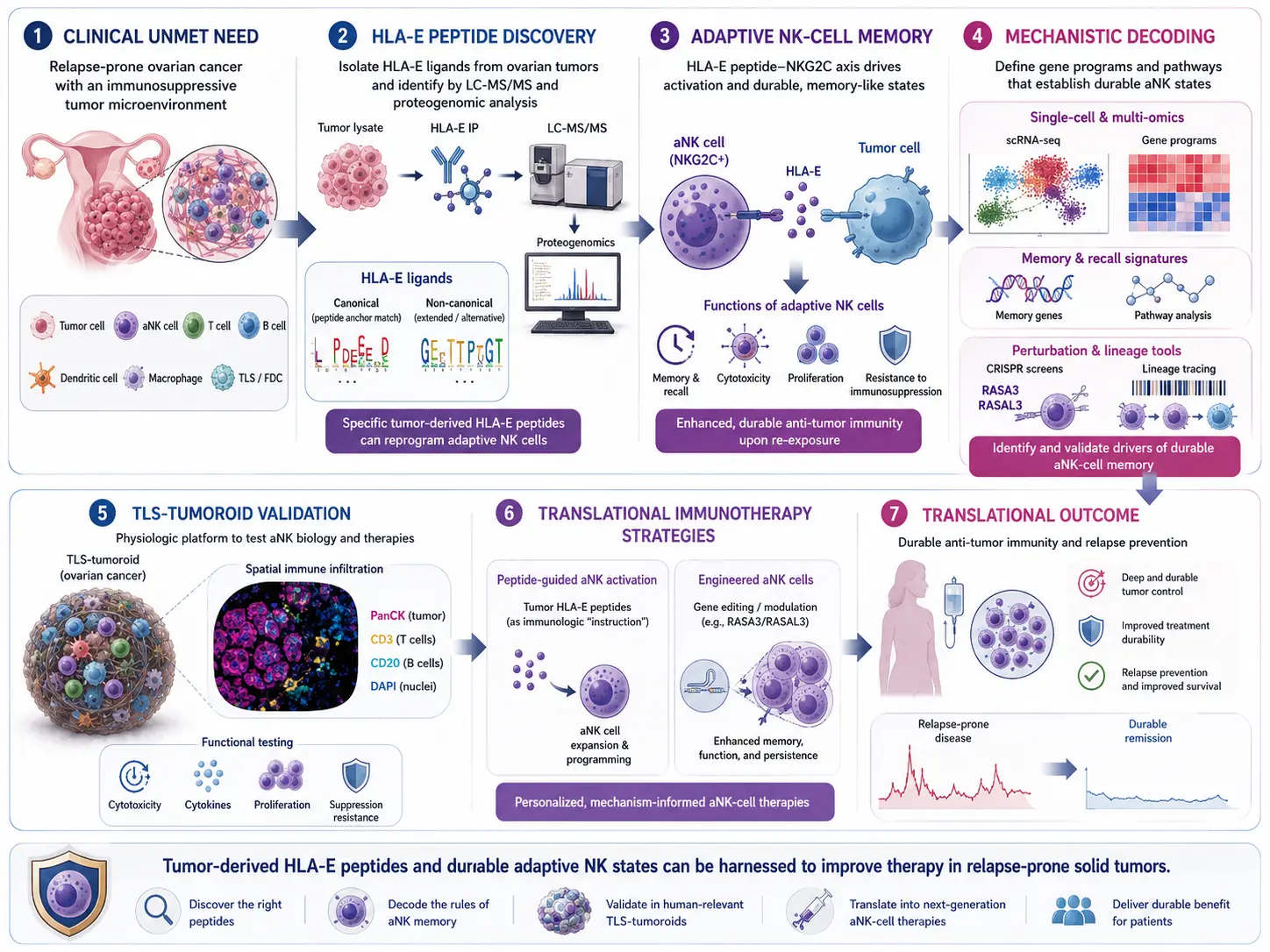
Research Line II studies how to use the immune system's natural killer (NK) cells to fight solid tumors. By understanding how tumors interact with NK cells and how long-lasting NK-cell responses develop, the team aims to create personalized and durable cancer immunotherapies.
Project I
Tumor-derived HLA-E peptides and adaptive NK-cell memory
This project investigates how tumor-derived HLA-E peptides regulate adaptive NK-cell activation, memory formation and tumor recognition. We isolate HLA-E ligands from ovarian tumors and characterize them using immunoprecipitation, LC-MS/MS and proteogenomic analysis. We functionally test whether these peptides can reprogram adaptive NK cells and induce memory-like anti-tumor responses. The goal is to identify tumor peptide programs that can convert HLA-E from an immune-evasion pathway into an activation axis for adaptive NK-cell immunotherapy.
Project II
Decoding durable adaptive NK-cell states
This project defines the molecular programs that support durable adaptive NK-cell function in solid tumors. Using single-cell RNA sequencing, RNA velocity and functional recall assays, we identify NK-cell states and gene programs associated with memory, persistence and tumor-reactive function. Our analyses have identified memory- and recall-associated gene signatures in adaptive NK-cell clusters, providing a basis for mechanistic studies of how these cells acquire long-term anti-tumor activity. We also use perturbation and lineage tools, including CRISPR and evolving barcode strategies, to test candidate regulators of adaptive NK-cell proliferation, phenotype and function.
Project III
TLS-tumoroid models for translational NK-cell immunotherapy
This project develops immune-integrated TLS-tumoroid models to test adaptive NK-cell biology in a more physiologically relevant tumor microenvironment. These models allow us to study antigen presentation, immune-cell infiltration, spatial organization and recall responses in tumor-like structures. Using ovarian TLS-tumoroids, we can examine how adaptive NK cells interact with tumor cells, T cells, B cells and stromal-like compartments, and test peptide-guided or engineered NK-cell strategies under tumor-relevant conditions. The long-term aim is to translate tumor peptide discovery and adaptive NK-cell programming into personalized and durable immunotherapy strategies for ovarian cancer and other solid tumors.