

Research line I: Sex-dependent macrophage-centered immune architecture in pancreatic cancer
Pancreatic ductal adenocarcinoma (PDAC) is highly resistant to immunotherapy, not only because immune cells are absent or dysfunctional, but because they are spatially constrained within a dense and suppressive tumor microenvironment. Our group investigates how this immune architecture is organized, how it differs between females and males, and how it can be targeted therapeutically.
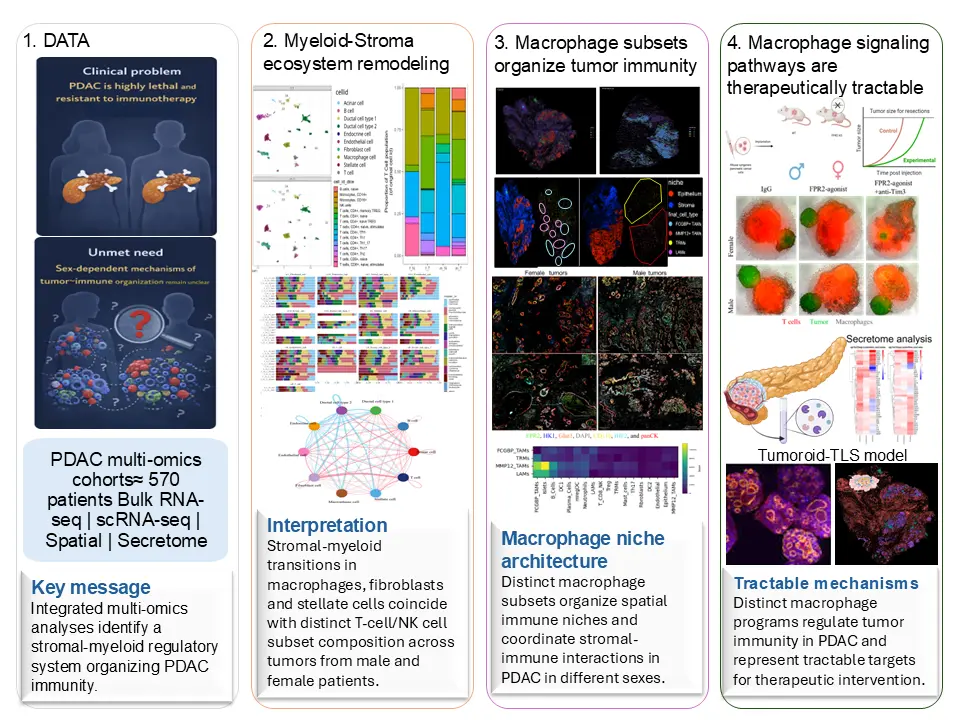
Our central concept is that PDAC tumors are not uniformly immunosuppressive. Instead, they form distinct macrophage-centered immune states in which macrophage subsets act as spatial organizers of tumor immunity. These macrophage programs regulate immune exclusion, stromal remodeling, epithelial–stromal interactions, TLS-like immune organization and metabolic adaptation. Importantly, our data indicate that these immune architectures differ systematically between female and male patients.
Using bulk RNA-seq, single-cell profiling, spatial transcriptomics, multiplex imaging, secretome analyses, patient-derived material and functional perturbation models, we aim to define how sex-dependent macrophage programs shape disease progression and therapeutic response in PDAC. The long-term goal is to identify biomarkers and targetable immune states that can support more precise and sex-informed immunotherapy strategies.
Project I
Mapping sex-dependent macrophage immune architecture
This project defines how macrophage subsets organize the spatial immune landscape of GI-tract cancers in female and male patients. We integrate multi-omics datasets from PDAC cohorts, including bulk RNA-seq, single-cell RNA-seq, spatial transcriptomics, multiplex immunofluorescence and secretome profiling. A central focus is to understand how distinct macrophage subsets occupy specific tissue niches and act as spatial organizers of tumor immunity. The aim is to generate a quantitative map of sex-dependent macrophage niche organization in PDAC and identify the cellular interactions that regulate immune exclusion, immune infiltration and tumor–stroma remodeling. By studying these spatial niches, we aim to understand how macrophages coordinate tumor immunity, stromal barriers and lymphocyte positioning in a sex-dependent manner.
Project II
Sex-biased soluble immune mediators and biomarkers in GI-tract cancers
This project investigates whether sex-dependent macrophage and immune programs can be detected through soluble mediators in patient plasma and tumor secretome profiles. We examine plasma and tumor-associated proteomic signatures from female and male pancreatic cancer patients using mass spectrometry and complementary secretome analyses. Our goal is to identify circulating proteins, cytokines, chemokines, metabolites and hormone-associated mediators that reflect sex-biased immune regulation, macrophage activity and tumor–stroma remodeling. These soluble factors may provide clinically accessible biomarkers of immune state, disease progression and therapeutic vulnerability.
Project III
FPR2-positive macrophage niches and immune exclusion
This project builds on our published finding that FPR2 shapes an immune-excluded pancreatic tumor microenvironment and drives T-cell exhaustion in a sex-dependent manner. FPR2-positive macrophages are enriched in female PDAC and are associated with suppressive immune organization, providing a mechanistic entry point for sex-informed immunotherapy.
We now investigate how FPR2-positive macrophages interact with tumor cells, stromal compartments and metabolic regions of the TME. Using multiplex imaging markers, we study how macrophage localization relates to epithelial remodeling, hypoxia, glycolysis and immune exclusion. The goal is to determine whether FPR2-positive macrophage niches represent therapeutically tractable immune states and whether they can be used to stratify patients for macrophage-targeted or sex-informed treatment strategies.