

Research Focus
It remains unclear why some older adults develop memory and learning impairments in neurodegenerative diseases such as Alzheimer’s and Parkinson’s, while others retain cognitive function despite similar brain pathology. Increasing evidence suggests that this variability may be driven by the selective vulnerability of specific brain regions and distinct neuronal and glial cell populations.
Our lab investigates the functional mechanisms underlying cognitive decline, with a focus on vulnerable brain regions such as the hippocampus and prefrontal cortex. We combine ex vivo electrophysiology, including patch-clamp recordings, circuit analysis, and measurements of neuronal oscillations and synaptic plasticity, with advanced imaging, transcriptomics, and proteomics. This integrative approach allows us to link molecular changes to alterations in neuronal and network function.
Neuron–microglia interplay in early Alzheimer’s disease
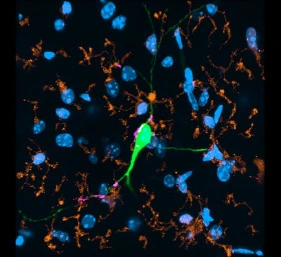
Our research has revealed that microglia (the brain’s resident immune cells) play a key role in the early stages of Alzheimer’s disease. We identified a critical transition phase in which changes in microglial state closely coincide with emerging disruptions in hippocampal network activity and function (Pizzirusso et al., 2024).
These findings highlight neuroinflammation as an early driver of circuit dysfunction and cognitive decline, suggesting that targeting microglial responses could open new opportunities for early intervention. Building on this work, we are now investigating the precise cellular and molecular mechanisms that link microglial alterations to neuronal dysfunction.