Cancer Proteogenomics and Precision Medicine in Acute Lymphoblastic Leukemia (ALL) – Rozbeh Jafari's Team

This research maps molecular profiles in acute lymphoblastic leukemia (ALL) using advanced omics to identify targeted therapies. By integrating proteogenomics and thermal proteomics, it explores how genomic changes affect the proteome and drug response. The goal is to improve therapies and translate findings into clinical practice for better patient outcomes.

Our research

We are utilizing and integrating state-of-the-art omics methods to obtain detailed molecular phenotypes of childhood and adult acute lymphoblastic leukemia (ALL), aiming to identify precision medicine candidates for improved therapy. Building on our recent studies (Leo, I.R. et al., Nat Commun 13, 1691 (2022), PMID:35354797, Kurzawa, N. et al., Nat Chem Biol 19, 962–971 (2023), PMID:36941476), we are advancing the study and validation of precision medicine candidates, with a strong focus on their translational implementation.

A fundamental question we are currently addressing is how cancer genome aberrations influence the functional proteome by combining genomics with proteomics data, a field known as cancer proteogenomics. In addition to quantitative proteomics, we are enhancing our analysis by capturing the biophysical state of the proteome, regardless of its abundance, using thermal proteomics. This approach allows us to identify functional proteoforms as well as their association with drug sensitivity.

Furthermore, we are investigating the target landscape of current and emerging targeted therapeutics using orthogonal chemical proteomics approaches to understand their mechanisms of action and potential toxicities. Our research also focuses on molecular and cellular biology, aiming to translate our findings into clinical applications that can significantly improve patient outcomes.
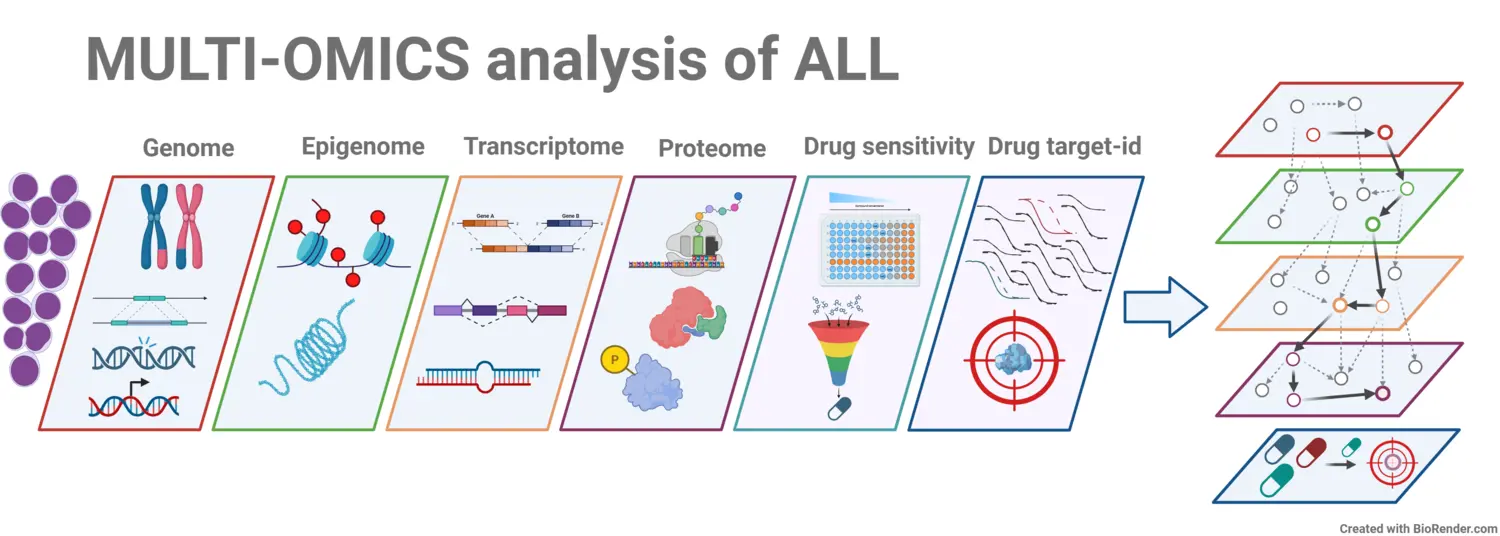
Schematic illustration of multi-omics analysis of acute lymphoblastic leukemia.
Functional Omics Resource of acute lymphoblastic leukemia (FORALL). An integrative approach combining genomic, transcriptomic, epigenomic, and proteomic data with drug sensitivity profiles is used to identify molecular subtypes and potential targets for precision therapy.

Publications

Selected publications

Funding

Grants

  • Integrative multi-omics for mechanistic insights into acute lymphoblastic leukemia for precision therapies
    Swedish Cancer Society: Senior Investigator Award
    1 July 2024 - 30 June 2027
  • Integrative multi-omics for mechanistic insights into acute lymphoblastic leukemia for precision therapies
    The Swedish Cancer Society
    1 January 2024 - 31 December 2026
  • Swedish Cancer Society
    1 January 2024
    Leukemia is a form of cancer that arises from the bone marrow and blood. They are the most common type of cancer in children, but most cases of leukemia occur in adults, where the prognosis worsens with increasing age. Although some patients recover with standard treatment, there is a need for new therapeutic markers and individualized drugs that can help those patients who do not respond to treatment, as well as for patients who develop resistance and relapse after initial successful treatment. Although the understanding of basic biological processes in cancer has increased significantly, these advances do not reflect the clinical picture. ALL is a heterogeneous disease where genetic studies have traditionally only been used to explore its biology. This has played a significant role in the classification of the disease, but unfortunately has not led to more individualized treatments. A major reason for this limitation is that genetic studies cannot depict the true phenotypic environment of the cells. The cellular environment of the cancer cells is better depicted by proteins because they constitute the final phenotype. By now combining mass spectrometry-based proteomics in combination with pioneering thermal proteomics and drug screening, we want to redefine the biology of ALL. One of the goals is to use a new, unique perspective to generate new knowledge that creates a better understanding of the disease mechanisms in ALL in adults. The ultimate goal is to identify new unique markers for better risk stratification as well as promote the development of more effective individually tailored drugs with fewer side effects for a more successful fight against the disease.
  • KI Research Foundation Grants 2024-2025
    1 January 2024 - 31 December 2025
  • Barncancerfonden
    1 January 2022 - 31 December 2022
  • National Natural Science Foundation of China
    1 January 2019 - 31 December 2022
  • National Natural Science Foundation of China
    1 January 2019 - 31 December 2022
  • National Natural Science Foundation of China
    1 January 2018 - 31 December 2020
  • Predictive therapeutic and resistance biomarkers in childhood leukemia using chemical proteomics
    The Swedish Childhood Cancer Fund
    1 January 2017 - 31 December 2019
  • National Natural Science Foundation of China
    1 January 2017 - 31 December 2020
  • Predictive therapeutic and resistance biomarkers in childhood leukemia using chemical proteomics
    The Swedish Childhood Cancer Fund
    1 September 2016 - 31 August 2021