

Projects in the COMBAT-MS frame work
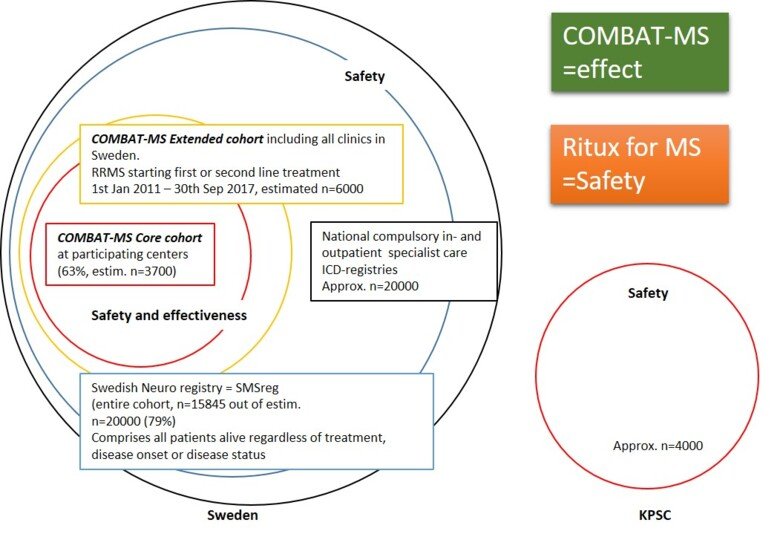
The image reflects the initial phase of COMBAT-MS, which comprised several projects based on different registries and databases.
COMBAT-MS “core” (the red circle in the image) was a prospective study in which nearly 4,000 people with MS were followed between 2017 and 2022. The study was conducted at all seven university hospitals in Sweden. Various measures of disease impact, including patient-reported outcomes, were collected at least annually. Blood samples and results from magnetic resonance imaging (MRI) examinations were also collected. Most of the data were recorded in the Swedish MS Registry, which is part of the Swedish Neuro Registries.
The study also included a registry-linkage component (the yellow circle in the image), comprising all people with relapsing MS who initiated disease-modifying treatment between 2011 and 2018—an estimated 6,000 individuals.
An extended component included several epidemiological studies (the blue and black circles in the image), in which all people with MS who had consented to participation in the Swedish MS Registry were potentially eligible.
Finally, studies were also conducted using medical data from Kaiser Permanente Southern California (KPSC). KPSC is a healthcare organisation serving several million residents of Southern California, including nearly 4,000 people with MS (the orange circle in the image).
In the current phase, we continue to follow the large Swedish participant cohort while incorporating additional data sources. The aim is to describe the course of MS in greater detail, improve our understanding of how disease mechanisms evolve over time, and assess the benefit–risk balance of different MS treatments.
During 2026, a database containing several tens of thousands of MRI examinations from COMBAT-MS participants in Stockholm was established. The aim is to generate quantitative MRI measures from these examinations during 2027. This work is led by Tobias Granberg and Russell Ouellette and includes AI-based analysis of brain MRI examinations.
In parallel, Thomas Frisell is leading efforts to access anonymised health data directly from electronic health record systems. These data include laboratory results, administered medications, diagnoses, and other clinical information. By combining these data with quantitative MRI measures, blood biomarkers, genetic information, registry data, and clinical and patient-reported outcomes, we will be able to investigate the benefits and risks of different MS treatments in substantially greater detail than previously possible.
This work is founded on the COMBAT-MS study and its clinical and patient-reported measures, which provide the clinical context needed to interpret the different data sources.
The continued research is supported by the Erling-Persson Foundation, the Swedish Brain Foundation, Region Stockholm, and the Swedish Research Council.