

Animal welfare and 3Rs
Karolinska Institutet strives to work continuously and from a broad perspective with the 3Rs. The overall policy is that no unnecessary experiments should be performed and that no animals should be subjected to experiments unless it is considered necessary.
What does 3R mean?
3R dscribes refining (refine), reducing (reduce), and replacing (replace) animal experiments where scientifically possible. This concept was formulated already in the 1950s by the researchers W.M.S. Russell and R.L. Burch, who wrote that all researchers should strive to use as few animals as possible and that animal welfare should be in focus when animal experiments are conducted.
Today, the 3R concept is a cornerstone of all animal research and is included in Swedish and European legislation governing laboratory animal activities. Everyone who works with laboratory animals must follow the 3R principle to conduct high-quality research and work to develop and use alternative research methods where scientifically possible.
That all research conducted on animals follows the 3R principle is also ensured through the animal ethics committee, which reviews and approves all animal experiments in Sweden.
Refine – refining and increasing the welfare of laboratory animals
Refining and increasing the welfare of laboratory animals means improving the animals’ environment and health and minimizing stress, pain, and other suffering. This can, for example, involve:
- Laboratory animals are acclimatized and trained ahead of various procedures. This may involve animals being trained to perform a certain task, becoming accustomed to a new environment, being handled by humans, or becoming accustomed to procedures such as blood sampling.
- The laboratory animal’s environment is enriched with objects they can explore or play with.
- Procedures performed on laboratory animals are improved and refined. This can involve replacing a major surgery with a less invasive procedure, administering drugs through a long-acting preparation implanted under the skin instead as with repeated injections, or providing special feed to animals after a procedure.
- Improved medication so that discomfort and pain are minimized.
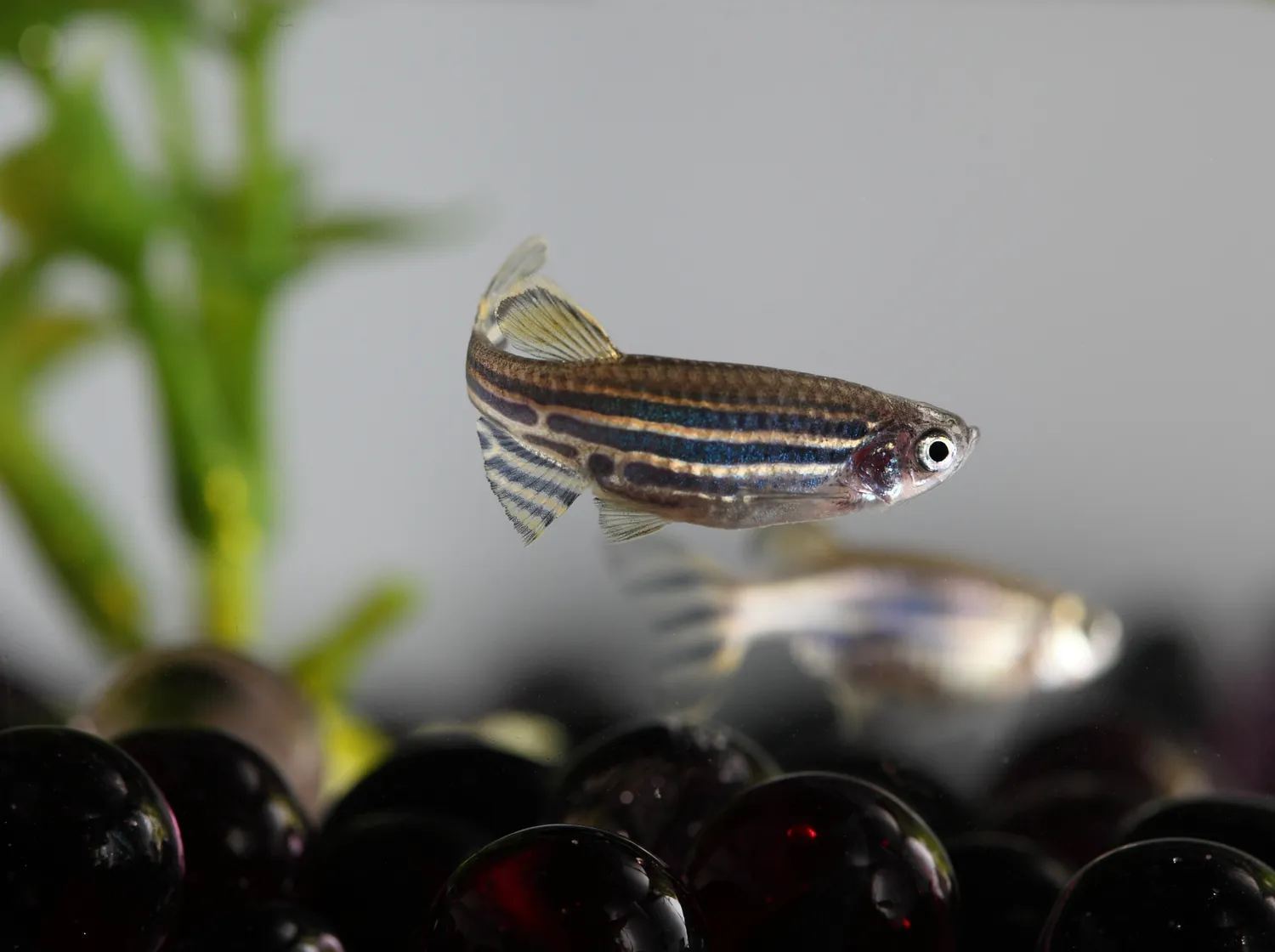
The zebrafish core facility developed new environmental enrichment for zebrafish
The zebrafish core facility at Karolinska Institutet developed enrichment for zebrafish aquariums that radically improved the housing of zebrafish in laboratory environments. The enrichment provides both protection and hiding places for the animals and does not negatively affect research. It is also designed so that it can be used in most zebrafish facilities worldwide, thereby contributing to more standardized housing, which in turn improves reliability and comparability between studies. The enrichment was published in the journal Zebrafish and was considered so important that it appeared on the journal’s cover.
Reduce – reducing the number of laboratory animals
Reducing the number of laboratory animals means using as few animals as possible in scientific experiments without compromising the quality of research data or increasing the suffering of the individual animal. This may, for example, involve:
- Ensuring good breeding planning, animal care, and staff competence to reduce the need to breed new laboratory animals.
- Using organs and tissues from the same animal in several different studies or sharing them with other researchers.
- Sharing and publishing animal studies that did not yield the expected results, so that they do not have to be repeated by other researchers.
Inside the Social Box: Modern tools for studying complex social behavior and stress
In the Lopez laboratory at Karolinska Institutet, researchers work to understand how stress affects the brain and body, and how new treatments can help the brain heal and people recover using animal models. To do this in the most humane way, the researchers use modern methods that improve the wellbeing of the animals in their studies.
One of the most important tools is a “Social Box”, a large enriched space where groups of mice can live freely, explore, and interact naturally. These “social boxes” are equipped with advanced data systems and artificial intelligence that automatically track and analyze how mice behave together in groups.
Unlike traditional behavioral methods, the Social Box allows animals to live in a much more natural and comfortable environment. Their behavior is automatically recorded from above, so that no researcher needs to enter the room and disturb them. Because each mouse is followed over long periods, researchers can learn much more from fewer animals.
Replace – replacing animal experiments
Replacing animal experiments means using animal-free methods instead of live animals when possible. According to Swedish legislation, animal experiments may only be used if no other methods provide equivalent results. This may include, for example:
- using so-called in silico models (mathematical models or artificial intelligence)
- using various types of cell models, such as cell cultures, organoids, or so-called “organ-on-chip”
- using mannequins or other models that can replace animals, for example for educational purposes

Researchers use brain organoids instead of mice in Alzheimer’s research?
Ivan Nalvarte is a researcher at the Department of Neurobiology, Care Sciences and Society at Karolinska Institutet. He researches sex differences in the onset and progression of Alzheimer’s disease. The research field widely uses mice for experimental studies of the brain. However, it has been shown that mice are much more resistant than humans to neurodegeneration. Mice do not naturally develop dementia diseases. Therefore, multiple mutations in risk genes are often required to recreate human pathology in mice.
In his research, Ivan Nalvarte uses human reprogrammed stem cells from adult individuals, with and without Alzheimer’s disease, and differentiates them into so-called brain organoids: small clusters, 1–2 mm in diameter, of nerve and glial cells that interact and mimic a small mini-brain. Unlike mice, these organoids follow a more relevant disease progression for humans, including exhibiting the amyloid pathology characteristic of humans followed by neurofibrillary deposits—something not seen in mice.
Therefore, there are hopes that brain organoids may be a more relevant model than mice for certain research questions. However, brain organoids in Alzheimer’s research are still only a complement to animal studies. Organoids can address specific molecular questions regarding disease onset, but it is still difficult to recreate all cell- and age-dependent disease processes, including the typical memory- and behavior-related pathology.
Method development around brain organoids is progressing rapidly, and there are great hopes, not least within the pharmaceutical industry, to be able to use brain organoids in the near future—both for drug screening and for understanding the molecular mechanisms behind early disease progression in Alzheimer’s disease.