

Project description INCLUDE
INCLUDE is a four-year research project aimed at strengthening lower secondary students’ learning and participation in the classroom, with a particular focus on students with Developmental Language Disorder (DLD), those with language or literacy challenges for other reasons.
INCLUDE is funded by a project grant in educational sciences from the Swedish Research Council (2025-2028) and is a collaboration between researchers at Karolinska Institutet and Uppsala University in Sweden and Southern Cross University in Australia.
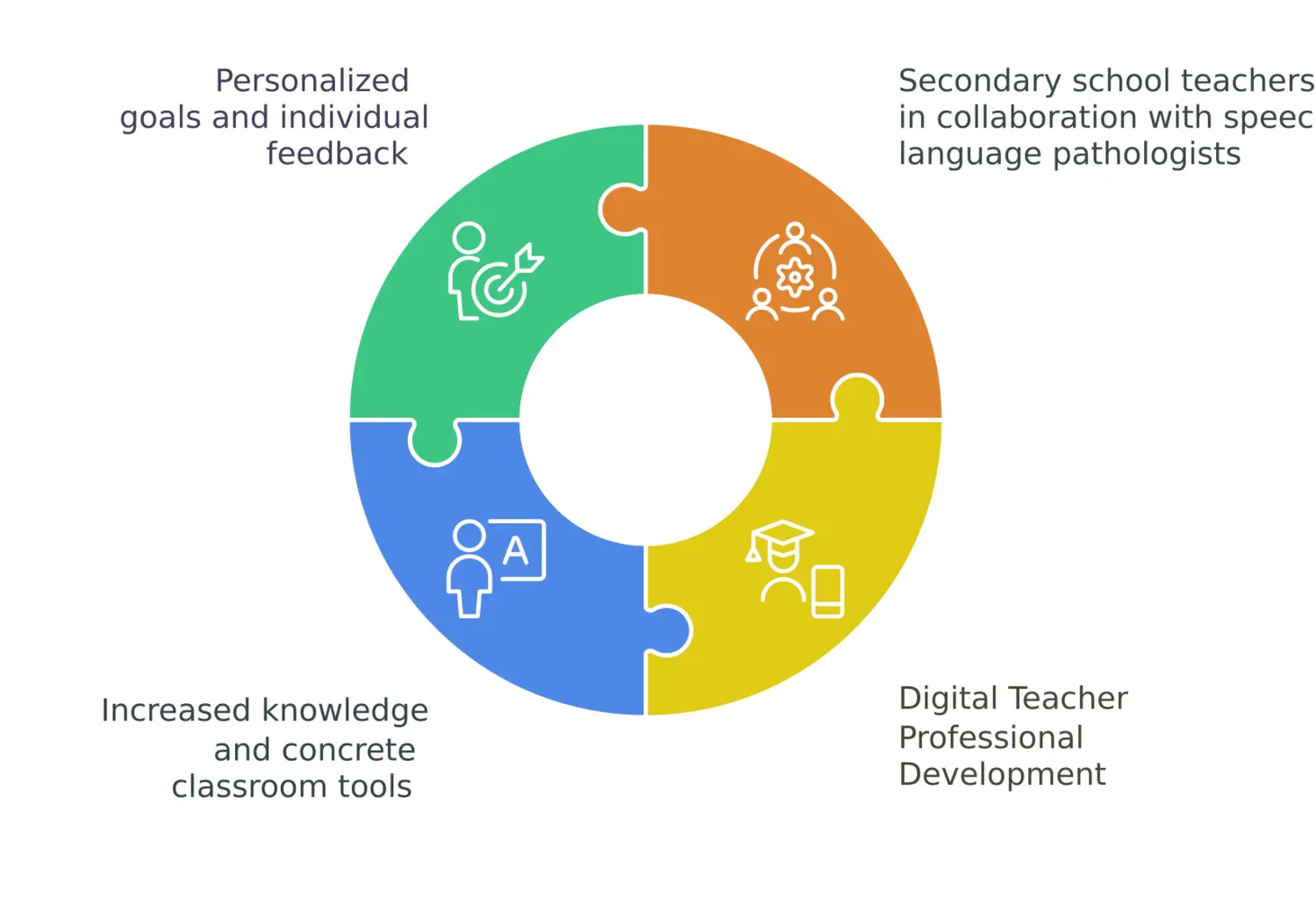
The project develops and tests LINK-D, a digital professional development programme for secondary school teachers. LINK-D comprises short digital micro-lessons over eight weeks and is based on research on language, reading and writing development and challenges, as well as cognitive science. The programme introduces teaching techniques that can be used in regular teaching in all secondary school subjects and includes short texts and videos, reflection tasks, individual goals, opportunities to discuss with colleagues, and many concrete examples.
Through LINK-D, teachers gain increased knowledge about language challenges and consequences in the classroom; concrete teaching techniques for making oral and written language accessible in their regular teaching; and support for working explicitly with words and concepts in their own subject.
LINK-D is based on the Australian research-based professional development program LINK-S (Linking Language with Secondary School Learning: Starling et al. 2012), and previous studies have shown positive effects for both students and teachers.
A central component of LINK-S is interprofessional collaboration between speech pathologists and teachers. In INCLUDE, a selection of participating teachers will receive individual coaching by a speech pathologist as part of LINK-D, to investigate how this collaboration affects the possible effects of the continuing education.
The goal of LINK-D is to make regular teaching in secondary school accessible to all students, regardless of whether they have language challenges or not.
INCLUDE Phase 1, July 2025-December 2026
The English version of LINK-D is being developed together with Professor Nat Munro and Dr. Julia Starling, and is being piloted with five secondary school teachers in Australia.
Preliminary pilot results will be presented at the International Developmental Language Disorder Research Conference (IDLDRC) and the University of Sydney Speech Pathology Research Symposium in October 2026
INCLUDE Phase 2, January 2027-July 2029
The Swedish version of LINK-D will be developed with the help of feedback from Swedish secondary school teachers.
LINK-D will then be tested and evaluated in about 20 Swedish secondary schools during the academic year 2027-2028. The focus is on teachers who teach the same one or two target classes in grade 8. Regular secondary schools throughout Sweden can participate in the project.
Three focus teachers in social or natural science subjects per school participate in in-depth data collection. All other teachers who teach the class(es) in question can also choose to participate in LINK-D and associated limited data collection. A selection of participating schools will also be offered individual coaching by a speech pathologist for participating focus teachers. Which schools are offered coaching is randomly allocated.
The project will include 100-250 teachers, 750-1000 of their students in grade 8, and around 10 speech therapist coaches.
Recruitment for the project will start after ethical approval, in the first part of 2027.
What will we investigate in INCLUDE?
In INCLUDE, we will investigate whether LINK-D can improve students' learning and learning experience in social and natural science subjects, and whether teachers' participation in the program affects students' vocabulary, reading comprehension, grades and sense of belonging in school more generally. In addition, the project will provide knowledge about which students benefit most from LINK-D – for example, students with and without developmental language disorder (DLD) and dyslexia, or students with Swedish as a second language, and whether the support from a speech pathologist is central for the potential results.
In the longer term, the results can contribute to more inclusive teaching and better support for students with different language conditions in school.
We want to answer the following research questions:
- To what extent do secondary school students whose teachers have participated in LINK-D show improvements in language and literacy skills, learning outcomes, and student-reported classroom experiences, and do the effects differ between different groups of students?
- Can student effects be explained by the teacher's knowledge and use of the teaching techniques in the classroom and the time they have spent on the professional development programme?
- To what extent do students' results differ between teachers who participate in LINK-D with digital coaching by a speech pathologist and teachers who have completed LINK-D without such coaching?
To answer these research questions, the researchers will collect information from teachers, students and speech therapist coaches. The data collection is mainly digital, and participating schools will have support from the researchers throughout the project period.
We hope that INCLUDE will contribute with important knowledge about how teachers can create inclusive classrooms where all students have better conditions to succeed.